
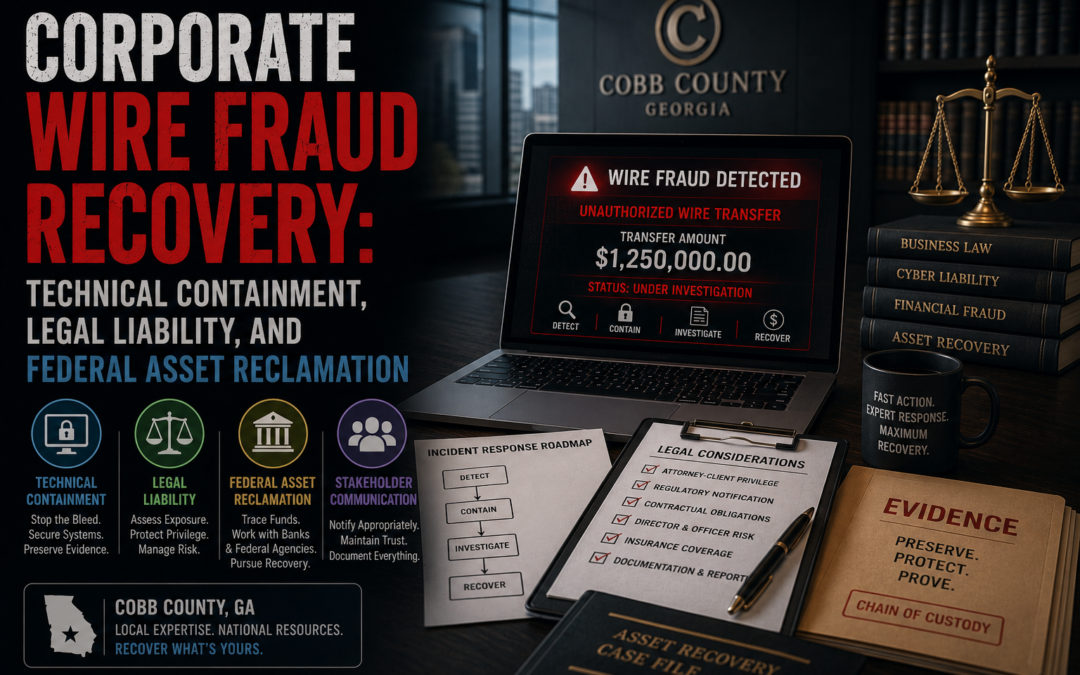
Executive Triage Summary: If your business just discovered a fraudulent wire transfer, stop disbursements immediately, do not power down affected machines, and call your bank's Wire Fraud and Risk Operations Department directly — not the local branch or general 800 line — to request a SWIFT or Fedwire recall within the first 24 hours. Simultaneously file a complaint at IC3.gov to trigger the FBI's Recovery Asset Team, since recovery odds drop sharply after the first three days.
Key Takeaways
- A 24-hour Hold Harmless window is the difference between a fast bank-level recall and a multi-year Breach of Warranty claim.
- The median B2B BEC wire diversion totals $185,400 in combined theft, idle labor, revenue drain, and SLA penalties over a single 24-hour outage.
- Under UCC Article 4A, a properly authenticated commercial wire is final — your bank has no obligation to reverse it, unlike consumer transfers under Reg E.
- Filing through IC3.gov within 72 hours is the only way to qualify for the FBI's International Financial Fraud Kill Chain (FFKC) on transfers over $50,000.
What Are the Warning Signs of a Wire Transfer Diversion?
There is no ransom screen, no system freeze, and no immediate visual indicator. The first sign is almost always a vendor calling to ask why an invoice is unpaid — by then, funds are already gone. Forensic review typically reveals a threat actor hijacked an active email thread and swapped a legitimate invoice PDF for one carrying altered routing and account numbers.
The mechanism is domain spoofing: attackers register lookalike domains using character substitution, such as swapping an "m" for "r" and "n," or appending "-inc" to a trusted vendor domain. These are built to defeat a casual glance at the sender field, not a forensic one.
Which Logs Reveal the Compromise?
| Log Source / Artifact | Event Identifier / Attribute | Forensic Value |
|---|---|---|
| Microsoft 365 UAL | New-InboxRule, Set-InboxRule, Add-MailboxPermission |
Identifies unauthorized mail-flow diversion rules and delegate access |
| Windows Security Logs | Event ID 4624 (Logon Type 3 & 10) | Flags malicious interactive or RDP access to domain-joined endpoints |
| Azure AD Sign-In Logs | Client App: IMAP4, POP3, SMTP, "Other clients" | Detects legacy protocol auth bypassing modern security defaults |
| Perimeter Firewall Logs | Target IP / outbound connections | Tracks persistent C2 connections from internal endpoints |
| M365 Audit Logs | MailboxLogin + riskDetail |
Surfaces anomalous mailbox access flagged by identity protection |
Why Doesn't a Password Reset Stop an Active BEC Attack?
Because a password reset does not invalidate active OAuth session tokens or browser cookies. In a real-world incident near the Barrett Parkway Financial District, a controller reset credentials through the standard admin portal believing it locked out the attacker — it didn't. The threat actor's session persisted, allowing them to monitor the remediation conversation in real time and send a second spoofed email impersonating the bank's "fraud investigator."
This is the signature of an Adversary-in-the-Middle (AiTM) phishing campaign, which captures live session state and bypasses both TOTP and push-notification MFA outright. Resetting a password without killing the session is functionally a no-op.
The correct remediation runs programmatically through Microsoft Graph PowerShell:
# Revoke all active sign-in sessions for the compromised user
Revoke-MgUserSignInSession -UserId user@domain.com

# Audit current authentication methods for tampering
Get-MgUserAuthenticationMethod -UserId user@domain.com

# Pull mailbox rule and permission changes from the Unified Audit Log
Search-UnifiedAuditLog -Operations New-InboxRule,Set-InboxRule,Add-MailboxPermission `
  -StartDate (Get-Date).AddDays(-14) -EndDate (Get-Date)
Following session termination, replace TOTP and push MFA with phishing-resistant FIDO2 hardware keys or certificate-based authentication, per FBI Cyber guidance. Pair this with quarterly log-review exercises and a rolling 12-month End-of-Life forecast so vulnerable systems don't linger past their useful security lifespan.
What Should You Do in the First Hour After Discovering Wire Fraud?
Follow the structured 10-step framework recommended by the American Land Title Association:
- Record the exact date and time of discovery; activate your internal incident response plan.
- Secure the physical and digital premises around affected endpoints.
- Take affected machines offline immediately — do not power them down or run scans before a digital forensics team arrives; both actions destroy volatile evidence.
- Document who discovered the breach, which systems are affected, and what assets were targeted.
- Interview key personnel to establish a timeline.
- Lock down internal communications to prevent accidental disclosure of breach details.
- Triage and prioritize the most urgent exposures.
- Engage a digital forensics firm for formal investigation.
- Consult legal counsel.
- Notify law enforcement once counsel has weighed in.
Accounting will typically freeze all outgoing disbursements during this window — this is correct, not excessive, and should remain in place until the compromised environment is confirmed contained.
What Is the True Cost of a 24-Hour Wire Fraud Incident?
The total economic impact extends far beyond the stolen principal. Total incident cost is modeled as:
$$C_{\text{incident}} = L_{\text{theft}} + \left(W_{\text{idle}} + R_{\text{drain}} + P_{\text{contractual}}\right) \times t$$
where $t$ is downtime duration in hours, $L_{\text{theft}}$ is the stolen principal, and $W_{\text{idle}}$, $R_{\text{drain}}$, and $P_{\text{contractual}}$ are hourly rates for idle labor, lost revenue, and contractual SLA penalties.
| Cost Variable | Cost Class | Base Rate | Cumulative Cost (24 Hrs) |
|---|---|---|---|
| Stolen Principal ($L_{\text{theft}}$) | Direct Financial Theft | $75,000 median B2B BEC wire | $75,000 |
| Idle Labor Waste ($W_{\text{idle}}$) | Operational Recovery | $1,100 / hour | $26,400 |
| Gross Revenue Drain ($R_{\text{drain}}$) | Business Interruption | $2,500 / hour | $60,000 |
| SLA Fines ($P_{\text{contractual}}$) | Contractual Liability | $1,000 / hour | $24,000 |
| Total Incident Cost | Cumulative Loss | — | $185,400 |
Will My Bank Reverse the Wire? Understanding UCC Article 4A
No — not automatically. Commercial wires are governed by UCC Article 4A, not the consumer-protection EFTA Regulation E. If your bank executed a transfer that was authorized with valid credentials and MFA, it has no legal obligation to reverse it once the wire clears Fedwire. The originating institution bears the loss, not the bank — this is the single most common misconception business owners carry into a fraud incident.
Insider nuance: Calling your local branch manager or filing a generic support ticket feels like the fastest path, but local branches typically lack direct access to federal recovery portals or international clearing systems. You need the Wire Fraud and Risk Operations Department specifically, reached through a verified internal contact — not the public 800 number, which adds administrative delay during the window that matters most.
Recovery proceeds via a SWIFT Recall Request (international) or Fedwire Recall Request (domestic), paired with a Hold Harmless Agreement / Letter of Indemnity. That agreement operates on a 24-hour return window. Miss it, and recovery shifts to a Breach of Warranty action — legally viable, but it carries a one-to-three-year statutory timeframe and substantially higher legal cost. You'll also be asked to sign a Fraud Affidavit attesting the organization didn't benefit from the transfer and will cooperate as a witness. Domestic wires clear through Fedwire or CHIPS, and recovered international funds must still pass OFAC sanctions screening before release.
How Do I Recover Stolen Funds Through Federal Channels?
Through the FBI's Recovery Asset Team (RAT), housed inside IC3 and operating since February 2018 to coordinate freezes between law enforcement and financial institutions.
International Financial Fraud Kill Chain (FFKC) — applies only when all four conditions are met: the transfer is $50,000 or greater, it's international, the sending bank has initiated a SWIFT recall, and the incident is reported to the FBI within 72 hours. Miss any one criterion and the transfer falls outside automated freezing eligibility, though it can still be reported.
Domestic RAT process — no minimum dollar floor. File a detailed complaint at IC3.gov; RAT contacts the receiving bank's fraud team to request an administrative freeze, then alerts the appropriate local FBI field office.
| Performance Metric | 2023 | 2024 | 2025 |
|---|---|---|---|
| Total Incidents Managed | 3,008 | 3,020 | Data not fully released |
| Attempted Theft Value | $758,052,433 | $848.4 million | Data not fully released |
| Stolen Assets Frozen | $538,394,998 | $561 million | Nearly $680 million |
| Freezing Success Rate | 71% | 66% | 58% |
The declining success rate underscores the same point repeatedly: speed of reporting, not transfer size, drives recovery odds.
Does Georgia's HB 1034 Protect My Business?
If you bank with a state-chartered Georgia institution, yes — in specific ways. HB 1034, signed by Governor Brian Kemp, requires those institutions to offer a free Account Safety Lock, activated online or by phone, which blocks new payees, zeroes outbound transfer limits, and terminates active sessions. The lock stays in place until you complete high-assurance re-authentication: in-person verification, notarized instructions, or a registered callback number.
The statute also requires institutions to pause a transfer and demand high-assurance re-authentication if they detect active remote-access software during the transaction — a direct response to remote-support-tool abuse in social-engineering scams.
Once fraud is reported, the bank must place a temporary emergency hold of up to 72 hours (extendable once, by 72 more hours, with a police report or law enforcement request) before final settlement. They must notify you of the hold within one business day and disclose the outcome within three business days of release, retaining records for five years.
For businesses in the Barrett Parkway Financial District, Town Center Kennesaw, and Marietta Square, coordinate state-level HB 1034 protections directly with local Cobb County law enforcement in parallel with the federal IC3 filing — the two tracks move independently and both should be opened the same day. A common local exposure point worth flagging proactively: financial staff using mobile accounting apps over unencrypted public Wi-Fi along regional transit corridors, which exposes session data to localized interception.
How Do I Prevent the Next Wire Fraud Attempt?
- Dual-channel validation: Any change to vendor routing numbers or payment schedules must be confirmed by phone, using a number pulled from the vendor's official website or signed contract — never the number listed in the email request itself. Skip general 800 numbers when verifying with your own bank during an active incident.
- Two-stage transaction validation: For high-value transfers, send a small random test amount first. The recipient must verbally confirm the exact amount received over a trusted phone line before the remaining balance moves.
- Segregation of duties: No single employee should be able to both initiate and approve a wire. Require two independent, authorized signatories before clearance.
- Identity hardening: Eliminate legacy authentication protocols and migrate to phishing-resistant MFA across the directory, closing the exact gap that enabled the original AiTM compromise.
Isolate Your Infrastructure with IT Emergency Room
A frozen wire and a live attacker session are two separate emergencies, and most internal IT teams are only equipped to handle one of them. IT Emergency Room is Cobb County's Tier-3 on-site escalation unit for active business email compromise and wire fraud events — covering the Barrett Parkway Financial District, Town Center Kennesaw, and Marietta Square corridors with rapid on-site session termination, forensic log capture, and direct coordination with your bank's Wire Fraud and Risk Operations Department while the 24-hour recall window is still open.
If you suspect an active compromise right now, do not reset passwords through the standard portal and do not power down affected machines. Call the IT Emergency Room hotline immediately to begin session-level containment before the next spoofed email goes out.