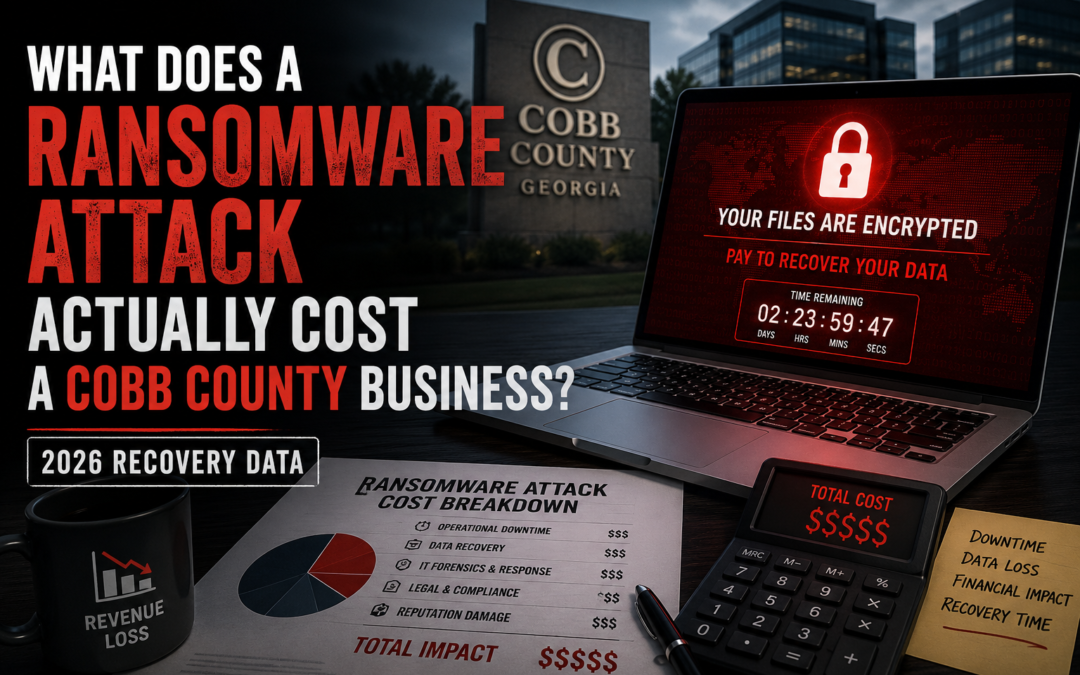
Executive Triage Summary: The first 60 minutes determine your total loss. Isolate every infected endpoint from the network immediately — do not power down encrypted machines, as this destroys volatile memory evidence — and route all decisions through a single incident commander before calling a national forensic firm, since most demand a non-refundable $20,000 retainer before touching a log file. Median out-of-pocket recovery for an SMB with intact, isolated backups is $375,000; with compromised backups, it jumps to $3,000,000.
Key Takeaways:
- Backup integrity is the single largest cost multiplier — compromised backups push median recovery costs from $375,000 to $3 million (8x).
- Downtime, not the ransom, is usually the largest line item — idle payroll and revenue drain commonly exceed $3,700/hour for a mid-market firm.
- Paying a sanctioned threat actor carries strict-liability federal exposure — OFAC civil penalties run up to $377,700 per transaction regardless of intent.
- Georgia law requires breach notification "without unreasonable delay" under O.C.G.A. § 10-1-912, with state AG notice mandatory above 10,000 affected residents.
What Are the First Signs of an Active Ransomware Attack?
The transition from normal operations to active crisis is abrupt: visual screen corruption, unmountable volume alerts on file servers, or a blunt extortion note dropped onto multiple endpoints simultaneously. By the time these signs appear, encryption is usually already in progress across shared drives, accounting databases, and CRM platforms.
Do not power off affected machines — this clears volatile RAM that may hold encryption keys or attacker fragments. Instead, pull network cables or disable the switch port to contain lateral spread.
Immediate triage checklist:
- Disconnect affected hosts from the network (do not shut down).
- Identify and isolate the central hypervisor (ESXi/Hyper-V) before it's targeted.
- Preserve, don't delete, any visible ransom note or extension-renamed files.
- Engage incident response before restoring from any backup.
Why Do National Forensic Firms Demand a $20,000 Retainer Up Front?
National cybersecurity firms routinely require a non-refundable $20,000 engineering triage retainer before deploying Endpoint Detection and Response (EDR) agents, acquiring a system image, or parsing a single log file. This cost lands precisely when cash flow is most uncertain — billing platforms and AR registers are frequently among the encrypted systems.
Once retained, responders deploy EDR tooling to scope the encrypted environment across accounting databases, CRM platforms, and local backup arrays. They calculate gigabytes-encrypted-per-hour, run block-level disk audits to assess bare-metal recovery feasibility, and audit firewall logs for exfiltration volume to determine whether the incident is single or double extortion (encryption plus data theft).
How Do Forensic Investigators Know If Attackers Erased Their Tracks?
They check for specific Windows Event IDs that indicate deliberate log tampering — discovering these early reshapes the entire investigation timeline and cost.
| Windows Event ID | Target Log File | Forensic Implications & Threat Actor Intent |
|---|---|---|
1102 |
Security | Audit log cleared; signals active evasion, privilege escalation, or credential dumping |
104 |
System | Log service halted or purged; hides lateral movement and service modifications |
1100 |
Security | Event Log service shutdown; indicates administrative access and system manipulation |
4688 |
Security | Process creation audit; tracks parent-to-child executable relationships and shell executions |
4719 |
Security | Audit policy modified; defensive evasion to suppress future event generation |
A quick PowerShell check for the most damaging entry, Event ID 1102:
Get-WinEvent -FilterHashtable @{LogName='Security'; Id=1102} | Select-Object TimeCreated, MessageIf this query returns a clean gap in the timeline, analysts must pivot to slower, more expensive methods: extracting physical memory dumps for RAM-resident event fragments, carving unallocated disk sectors for deleted .evtx remnants, and parsing Volume Shadow Copies for older configuration snapshots. Every hour spent on this reconstruction is billed at forensic engineering rates — log clearing alone can add days to an investigation.
What Is CVE-2023-27532 and Why Does It Matter for Veeam Backups?
CVE-2023-27532 is a critical vulnerability in Veeam Backup & Replication caused by a missing authentication check (CWE-306) on the remote WCF endpoint listening on TCP port 9401. An unauthenticated attacker who reaches that port can pull encrypted administrative credentials directly from the configuration database and decrypt them offline.
Because those credentials govern access to the broader network, this single flaw lets an attacker pivot from a compromised backup server to both production systems and secondary storage — the exact scenario that turns a recoverable incident into a $3 million one.
Check exposure with:
netstat -ano | findstr 9401Remediation priority: patch to Veeam Backup & Replication 12.1.0.2131 or later, restrict TCP 9401 to management-segment traffic only, and place backup infrastructure on a network segment with no inbound path from user VLANs.
Why Are Cobb County Office Parks at Higher Ransomware Risk?
Dense commercial corridors — the Barrett Parkway Business District, Kennesaw Town Center, and the Marietta Square executive suites — frequently share multi-tenant utility and network closets. Tenant traffic is often routed through a shared communication vault without logical or physical separation between businesses.
That lack of isolation means ransomware can spread laterally beyond a single tenant's footprint, and it frequently takes the on-premises, network-attached backup array down along with production systems — eliminating any chance of a fast local restore.
The Cobb County Government Breach: A Local Case Study
In March 2025, the Qilin ransomware-as-a-service group breached Cobb County government networks, ultimately claiming roughly 150 gigabytes of data across more than 400,000 files, including Social Security numbers, driver's license images, and internal government documents. Cobb County declined to negotiate, stating it would not support or enable criminal enterprises, took systems offline, and ran a manual forensic investigation rather than trust the threat actor's tooling.
This incident is a useful local reference point precisely because it shows what happens when a well-resourced government entity still can't avoid an extended, public, multi-week recovery — small and mid-market tenants in the same office parks generally have far less redundancy to fall back on.
How Much Does Ransomware Downtime Actually Cost Per Hour?
For a typical mid-market professional services firm, idle labor waste runs $1,200/hour and gross revenue drain averages $2,500/hour — a combined $3,700 per hour of downtime, independent of any ransom paid.
$$L_{\text{total}} = (C_{\text{labor}} + C_{\text{revenue}}) \times H_{\text{downtime}}$$
Where $C_{\text{labor}}$ is the idle-payroll cost rate, $C_{\text{revenue}}$ is the hourly gross revenue drain, and $H_{\text{downtime}}$ is total hours of operational outage.
Case in point — Town Center Kennesaw corridor: A professional services firm fixated on a threat actor's $45,000 ransom demand, assuming that was the main exposure. The attacker's decryption tool then took six days to process the firm's file shares — during which the company absorbed $22,000 in idle payroll alone, before counting lost billable revenue. The ransom was the smallest number on the final invoice.
| Recovery Cost Metric | Value | Source |
|---|---|---|
| Median Ransom Payment (All SMBs) | $115,000 | Verizon DBIR |
| Avg. Recovery Cost ex-Ransom (100–250 employees) | $638,536 | Sophos State of Ransomware |
| Median Recovery Cost — Backups Intact | $375,000 | Sophos Backup Impact Research |
| Median Recovery Cost — Backups Compromised | $3,000,000 (8x) | Sophos Backup Impact Research |
| Global Avg. Breach Cost (under 500 employees) | $3.31M | IBM Cost of a Data Breach |
| Realistic Out-of-Pocket SMB Range | $120,000 – $1,240,000 | Verizon DBIR |
Backup integrity drives most of that spread: only 26% of firms with compromised backups recover within a week, versus 46% of firms with intact backups — the gap compounds every cost line above it.
Is It Illegal to Pay a Ransomware Gang? OFAC, GPIPA & Reporting Deadlines
Paying a threat actor on the Treasury's Specially Designated Nationals (SDN) List, or operating from a comprehensively sanctioned jurisdiction, exposes the paying business to strict-liability civil penalties from OFAC — meaning the business can be fined even if it had no idea the group was sanctioned. The inflation-adjusted cap is $377,700 per violation, or 2x the transaction value, whichever is greater, and penalties compound across sequential crypto payments.
At the state level, Georgia's GPIPA (O.C.G.A. § 10-1-912) requires notifying affected consumers "without unreasonable delay" — generally interpreted as within 30 days — whenever unencrypted names are exposed alongside Social Security numbers, driver's license numbers, or financial account credentials.
| Regulatory Framework | Reporting Threshold | Timeline | Non-Compliance Consequence |
|---|---|---|---|
| OFAC / IEEPA Sanctions | Any payment with SDN nexus | Immediate upon discovery | Strict-liability fines up to $377,700/transaction or 2x value |
| Georgia GPIPA | Unencrypted PII compromised | "Without unreasonable delay" (~30 days) | Class-action exposure; GA AG enforcement |
| Regulatory Framework / Georgia AG Notification | Breach affects 10,000+ GA residents | "Without unreasonable delay" | Formal regulatory investigation, public audit |
The insider nuance most businesses miss: if notification costs exceed $50,000 or the affected group tops 100,000 residents, GPIPA permits substitute notice (conspicuous website posting plus statewide media disclosure) instead of individual mailings — but only above that threshold. Smaller breaches don't qualify for the shortcut and require direct written or electronic notice to every affected individual.
This section is general regulatory information, not legal advice. Sanctions and breach-notification exposure should be reviewed with qualified counsel before any payment or disclosure decision is made.
Will Cyber Insurance Actually Cover My Ransomware Downtime?
Often only partially. Many cyber policies carry sublimits that cap payouts for ransomware, wire fraud, or social engineering events at a fraction of the policy's headline limit — even when the base policy advertises broad coverage. Adjusters frequently push back on business-interruption losses tied to slow decryption, arguing they fall under a restrictive ransomware sublimit rather than the policy's main limit.
If a carrier tries to apply a narrow sublimit, the practical move is to have coverage counsel evaluate whether the loss instead qualifies under a broader, non-sublimited category — such as Extra Expense or System Disruption coverage — since those categories are often unrestricted by the ransomware-specific cap.
Insurance coverage determinations are policy-specific and fact-dependent. This is general information, not a coverage opinion — have your policy reviewed by coverage counsel before relying on any characterization above.
Should You Pay the Ransom? What the Data Actually Shows
Paying is frequently a financial trap, not a fix. Threat-actor decryption tools are slow and unreliable — keys fail to fully restore data 30% to 40% of the time, forcing a manual rebuild regardless of payment. Roughly 80% of organizations that pay are targeted again within twelve months, and the OFAC exposure above applies whether or not the decryption works.
The defensible alternative is architectural, not transactional:
- Immutable, air-gapped backups — at least one copy with no live network path an attacker can reach or encrypt.
- 3-2-1 backup discipline — three copies, two media types, one offline/off-site.
- Segmented hypervisor management plane — ESXi/Hyper-V hosts isolated from general user VLANs, with patched Veeam or equivalent replication services.
- Tested restore runbooks — a backup that's never been restored in a drill is an assumption, not a recovery plan.
- EDR/XDR on every endpoint with centralized, write-protected logging so Event ID 1102 can’t quietly erase the trail.
Isolate Your Infrastructure with IT Emergency Room
If you're reading this mid-incident: stop deliberating and start isolating. Every hour of indecision compounds the $3,700+/hour downtime math above, and every minute an infected host stays on a shared Cobb County office-park network increases the odds your backup array goes down with production.
IT Emergency Room is the Cobb County Tier-3 on-site escalation unit — physically dispatched to the Barrett Parkway, Kennesaw Town Center, and Marietta Square corridors, with the forensic and hypervisor-recovery depth to contain a CVE-2023-27532-style breach before it spreads past your tenant suite.
Call the emergency response line now and get a responder routed to your location — don't wait on a national firm's $20,000 retainer queue while your file shares keep encrypting.