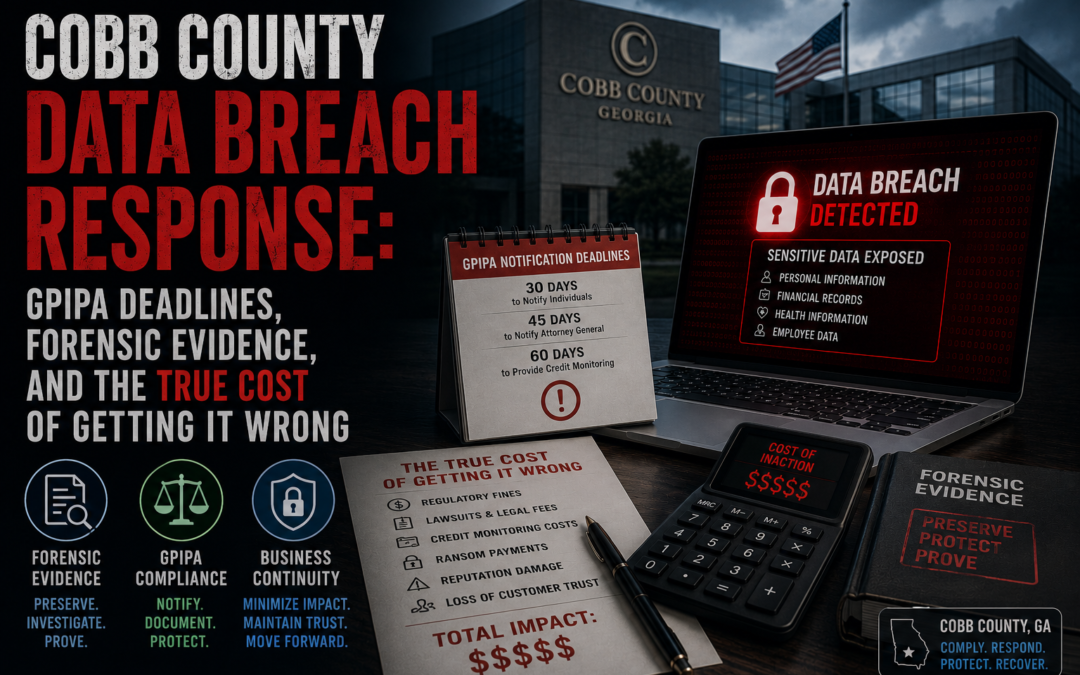
Executive Triage Summary: Under Georgia's GPIPA (O.C.G.A. § 10-1-912), affected residents must be notified "without unreasonable delay," downstream vendors have exactly 24 hours to alert the data owner of a suspected breach, and any incident touching more than 10,000 Georgia residents triggers mandatory notice to national consumer reporting agencies. Encryption is the only statutory safe harbor — and it evaporates the moment the decryption key is also stolen. If you're reading this mid-incident: isolate the affected systems now, do not reimage anything, and call IT Emergency Room's Cobb County response line before your own IT staff destroys the forensic evidence you'll need to prove what wasn't taken.
Key Takeaways:
- 24 hours — the statutory window a vendor or downstream data custodian has to notify the data owner under O.C.G.A. § 10-1-912(b).
- 10,000 Georgia residents — the threshold that converts a routine notification into a mandatory consumer reporting agency (CRA) filing under § 10-1-912(d).
- $1,787,500 — the modeled cumulative exposure for a single 15,000-customer breach once mailing, identity monitoring, and FBPA penalties are added up, before system restoration costs.
- Event IDs 4624, 4663, and 5140 — the three Windows artifacts that determine whether you can prove data wasn't exfiltrated, or whether you're forced into a mass-notification mailing.
Does Georgia Law Require You to Notify Customers After a Data Breach?
Yes, in nearly all practical cases. The Georgia Personal Identity Protection Act (GPIPA), O.C.G.A. §§ 10-1-910 through 10-1-912, is the controlling statute. Its text technically applies to "information brokers" (entities that compile and sell personal data to third parties for a fee) and "data collectors" (state and local government bodies, public universities, and school districts). Most Cobb County small and mid-market businesses don't fit either definition cleanly.
That gap doesn't mean private companies are exempt in practice. The Georgia Attorney General's Office treats a failure to notify consumers of a compromised environment as an unfair or deceptive trade practice under the Georgia Fair Business Practices Act (FBPA). The functional result: standard commercial entities operating in Marietta, Smyrna, Kennesaw, or anywhere else in the county should align with GPIPA's disclosure standards regardless of whether the narrow statutory category technically applies to them.
What Counts as "Personal Information" Under O.C.G.A. § 10-1-911(6)?
An individual's first name or initial plus last name, combined with at least one unencrypted, unredacted identifier — most commonly a Social Security number, a driver's license or state ID number, or a financial account, credit, or debit card number paired with the security code or password required to access it. Certain sensitive elements can trigger the same obligations on their own if their exposure is sufficient to enable identity theft. A 2024 amendment carved out one major exception: personal information that is already lawfully public via federal, state, or local government records no longer counts.
What Are Georgia's Breach Notification Deadlines?
There is no fixed day-count for notifying affected residents — the statute uses a "most expedient time possible" standard instead. Other parties in the chain face much harder deadlines.
| Parameter | Statutory Requirement | Reference |
|---|---|---|
| Notification to affected residents | Most expedient time possible, without unreasonable delay, consistent with law enforcement needs or scope determination | O.C.G.A. § 10-1-912(a) |
| Vendor / downstream data custodian to data owner | Exactly 24 hours from discovery or reasonable belief of unauthorized acquisition | O.C.G.A. § 10-1-912(b) |
| Consumer reporting agency (CRA) notice | Required when more than 10,000 Georgia residents are notified at one time | O.C.G.A. § 10-1-912(d) |
| State agency notice | Required for regulated licensees (e.g., money transmitters → Dept. of Banking and Finance) and schools under SB 89 | Ga. Comp. R. & Regs. 80-3-1-.04 / § 10-1-912 |
The 24-hour vendor clock is the one most Cobb County businesses get wrong. If your managed service provider, payroll processor, or SaaS vendor discovers unauthorized access to your data, their contractual silence for days while they "investigate internally" is not compliant — it's a liability they're quietly transferring to you.
Does Encryption Protect You From Notification Obligations?
Yes — encryption (or redaction) of the compromised personal information is the primary statutory safe harbor under GPIPA. If the data was properly encrypted, the notification requirements simply don't apply. That protection disappears immediately, however, if the encryption key, administrative password, or any credential capable of decrypting the files was also accessed or acquired during the same incident. An attacker who steals an encrypted database and the key sitting in a config file next to it has functionally stolen unencrypted data in the eyes of the statute.
What Forensic Evidence Determines Whether You Must Notify?
GPIPA's "unauthorized acquisition" trigger does not require a visible crash, a ransom note, or a defaced login page. It's established through specific artifacts in centralized logs and host operating systems — which is why deleting or failing to retain those logs is often more damaging than the breach itself.
Windows Security Event Logs: Which Event IDs Actually Matter?
Three Event IDs carry the forensic weight in most Cobb County file-server investigations:
- Event ID 4624 — successful logon, used to establish Type 3 (network) authentication and lateral movement paths.
- Event ID 4663 — object access, the artifact that proves whether a specific file (spreadsheet, database export) was actually opened or copied.
- Event ID 5140 — network share access, used to scope which shared folders an account touched.
Without centralized syslog/SIEM retention, these events age out of local logs in days, often before an organization even realizes it needs them.
How Do You Investigate SharePoint and OneDrive Exfiltration?
The Microsoft Purview Compliance Center concentrates tenant-wide telemetry. Investigators query it with the Search-UnifiedAuditLog cmdlet, filtering for file download and sync operations:
Search-UnifiedAuditLog -StartDate 2026-06-01 -EndDate 2026-06-21 `
  -RecordType SharePointFileOperation `
  -Operations FileDownloaded,FileSyncDownloadedFull `
  -UserIds compromised.user@domain.com
How Do You Determine the Scope of a Compromised Mailbox?
MailItemsAccessed is the mailbox auditing operation that matters for cloud email compromises — it's enabled by default on Microsoft 365 E3 and E5 tenants. When a threat actor accesses mail via IMAP, MAPI, or REST, or syncs an entire folder, the forensic assumption is that every item in that synchronized folder is compromised — not just the items an analyst can individually confirm were opened. That presumption is exactly why employee W-2 folders and customer payment-profile attachments turn a single compromised mailbox into a mass-notification event.
Use the modern cmdlet — the legacy Search-MailboxAuditLog is deprecated:
Search-UnifiedAuditLog -RecordType ExchangeItem `
  -Operations MailItemsAccessed `
  -UserIds compromised.user@domain.com `
  -StartDate 2026-06-01 -EndDate 2026-06-21
How Do You Detect Data Scraping From an On-Premise Web Server?
For IIS-hosted line-of-business applications and exposed databases, native OS tools fall short. Microsoft's logparser runs SQL-like queries directly against IIS .log files to surface anomalous outbound transfers:
logparser "SELECT cs-uri-stem, sc-bytes, c-ip, TO_TIMESTAMP(date, time) AS EventTime
FROM ex*.log
WHERE sc-bytes > 5000000 AND cs-method = 'GET'
ORDER BY sc-bytes DESC"
This isolates large GET requests against directories hosting exports — the fingerprint of automated scraping rather than normal user browsing.
What Makes Cobb County Breaches Different?
Multi-tenant commercial real estate is the defining local risk factor. Medical plazas near Marietta Square, the Town Center Kennesaw business clusters, and the corporate parks across the Cumberland/Galleria submarket frequently share physical network switches, hypervisors, or unsegmented LANs across unrelated tenants. A lateral compromise inside one practice's environment can expose the unencrypted PII of the business next door — a risk most leases and IT contracts never explicitly address.
Who Do You Call in Cobb County After a Breach?
| Agency / Unit | Address | Contact | Jurisdiction |
|---|---|---|---|
| Cobb County Police Dept. (CCPD) HQ | 140 Fairground St, Marietta, GA | (770) 499-3900 | Central municipal authority, unincorporated Cobb County |
| CCPD High Tech Crime Squad | 5000 NASA Blvd, Suite 2100 | Sgt. J.V. Harder — jason.harder@cobbcounty.org / (770) 499-3872 | Digital forensics, identity theft, computer trespass |
| Cobb County Sheriff's Office | 1825 County Services Pkwy, Marietta, GA | (770) 499-4600 | Fraud, forgery, computer crimes investigation |
| Marietta PD Cyber Unit | 240 Lemon St, Marietta, GA | (770) 794-6990 | Digital evidence within Marietta city limits |
| Georgia Attorney General | 40 Capitol Square SW, Atlanta, GA | Consumer Protection: (404) 651-8600 | State civil enforcement, multi-state coordination |
Can You Delay Notification for a Law Enforcement Investigation?
Yes, but only through a formal process. Under O.C.G.A. § 10-1-912(c), notification can be delayed if a law enforcement agency formally determines that public disclosure would compromise an active criminal investigation. In Cobb County, that means contacting the CCPD High Tech Crime Squad or the CCSO Criminal Investigation Division immediately, filing a formal incident report, and obtaining a written directive from a detective. The clock stays paused only as long as the agency specifies — once they clear disclosure, notification must proceed without further delay.
What's Your Legal Exposure If You Don't Notify?
Georgia's statute doesn't create a private right of action for a bare notification-timeline violation, which is exactly why plaintiffs' attorneys pivot to common-law negligence, breach of implied contract, and unjust enrichment claims instead.
The controlling case is Collins v. Athens Orthopedic Clinic, P.A., 307 Ga. 555 (2019). After the "Dark Overlord" hacking group stole unencrypted Social Security numbers, dates of birth, and medical histories for roughly 200,000 patients and listed the data for sale, the trial court and Court of Appeals initially dismissed the case, holding that an increased risk of future identity theft was too speculative to be a cognizable injury. The Georgia Supreme Court reversed, holding that the elevated risk of identity theft from a confirmed data theft — not a mere vulnerability — can constitute a legally cognizable injury sufficient to proceed past dismissal. On remand, the Court of Appeals revisited the remaining tort and contract theories in light of that standing ruling. The practical lesson for Cobb County businesses: "we didn't see proof of misuse yet" is no longer a reliable defense once theft of unencrypted PII is established — consult counsel on how this precedent applies to your specific facts.
Why Does IT Clash With Legal During a Breach Response?
The instinct of a systems administrator is to contain and rebuild fast — wipe the compromised host, restore from backup, get the business running again. The instinct of corporate counsel is the opposite: preserve everything, because a forensic image taken after a reimage can't prove what was or wasn't accessed. Whoever wins that argument in the first two hours determines whether you're relying on hard evidence or guesswork when the GA AG's office or your cyber insurer starts asking questions.
Why Do SaaS Vendors Deny Responsibility?
In a shared-responsibility model, the default vendor posture during an active investigation is often deflection — a generic assurance that "no exfiltration occurred" without underlying log access to verify it. This is the "exfiltration myth": a claim of safety with nothing behind it. The fix is contractual, not technical — SLA provisions that force vendor transaction and application log disclosure on demand neutralize the deflection and make the 24-hour downstream notification deadline actually enforceable.
What Does a Breach Actually Cost Per Hour?
Forensic preservation holds idle staff, stall revenue-generating systems, and accrue vendor standby fees simultaneously. A simplified hourly cost model for quantifying that drain:
$$C_{hr} = R_{loss} + (N \times W_{avg} \times I) + F_{standby}$$
Where $C_{hr}$ is total hourly cost, $R_{loss}$ is hourly lost revenue from affected systems, $N$ is the number of idled employees, $W_{avg}$ is average burdened hourly wage, $I$ is the idle fraction (0 to 1), and $F_{standby}$ is the hourly forensic or vendor standby fee.
A real example: a professional services firm near Town Center Kennesaw had a legacy, unencrypted server share containing historical employee tax forms, accessed via a compromised legacy VPN profile. Because the firm had no centralized syslog retention, it could not prove to its cyber insurance carrier or state regulators that the data hadn't been exfiltrated. That single diagnostic gap — not the breach itself — forced a mandatory notification mailing campaign costing tens of thousands of dollars in regulatory expense, postage, and administrative overhead.
What's the Real Financial Exposure for a 15,000-Customer Breach?
| Cost Category | Unit Basis | Total Exposure |
|---|---|---|
| Forensic firm retainer | Flat rate + diagnostics | $25,000 |
| Legal advisory fees | Hourly counsel | $15,000 |
| Direct certified mailing | $4.50 × 15,000 consumers | $67,500 |
| Identity monitoring services | $12.00 × 15,000 (1-year plan) | $180,000 |
| FBPA potential penalties | Up to $100 × 15,000 violations | $1,500,000 |
| Cumulative total | Excludes system restoration | $1,787,500 |
How Do You Build a GPIPA-Compliant Technical Control Stack?
| Technical Control | Forensic Artifact Protected | Compliance Outcome |
|---|---|---|
| Centralized syslog/SIEM integration | Prevents loss of Event IDs 4624, 4663, 5140 | Immutable proof of access scope, defeats exfiltration claims |
| AES-256 full disk and database encryption | Renders Event ID 4663 file objects unreadable | Preserves the statutory encryption safe harbor under § 10-1-912(a) |
| MFA and network segmentation | Restricts Type 3 network logons (Event ID 4624) | Blocks lateral movement across shared multi-tenant infrastructure |
| M365 Advanced Auditing (E5) | Captures protocol-level folder syncs (MailItemsAccessed) | Limits presumed mailbox compromise scope, avoids mass notification |
| Contractual SLA log-disclosure clauses | Forces vendor transaction/application log access | Neutralizes vendor deflection, enables 24-hour notification mapping |
Implementation priorities, in order:
- Stand up centralized log retention (SIEM or syslog forwarding) with a minimum 12-month window before anything else — logs you don't have can't be reconstructed later.
- Encrypt data at rest with AES-256 across file servers and databases, and store keys separately from the encrypted volumes.
- Enforce MFA and segment shared-building LANs so a compromise in one tenant's environment can't reach another's.
- Upgrade mail-heavy tenants to M365 E5 for extended audit log retention and
MailItemsAccessedcoverage. - Rewrite vendor and MSP contracts to require log disclosure within 24 hours of a detected incident — not "upon completion of their internal investigation."
- Run a tabletop exercise with legal counsel and your playbook contacts before an incident, so the law enforcement delay process under § 10-1-912(c) isn't being learned in real time.
Isolate Your Infrastructure with IT Emergency Room
A breach gets more expensive every hour systems stay unsegmented and forensic evidence stays uncollected. IT Emergency Room operates as the Cobb County Tier-3 on-site escalation unit for exactly this scenario — physical isolation of compromised hosts, forensic-grade log preservation before anyone touches a reimage button, and direct coordination with the CCPD High Tech Crime Squad when a law enforcement delay needs to be invoked correctly.
If you suspect unauthorized access right now: stop rebuilding, stop deleting, and call the IT Emergency Room hotline immediately at itemergencyroom.com. Every minute spent guessing at scope is a minute closer to the $1,787,500 number above.