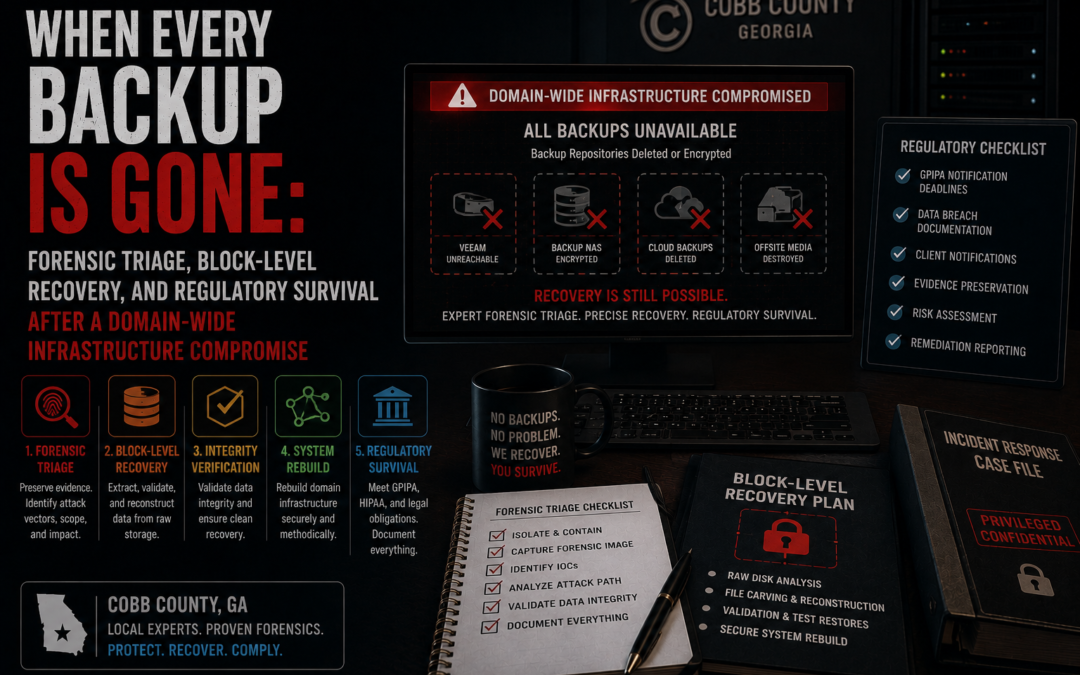
Executive Triage Summary: A domain-wide ransomware compromise that destroys both primary systems and all backup repositories is not a data loss event—it is a simultaneous technical, legal, and financial crisis. The window to preserve recoverable data on SSD and NVMe media is measured in minutes, not hours, and every standard software reboot permanently narrows it. Immediate physical power isolation, followed by forensic-grade hardware cloning, is the only sequence that preserves block-level recovery options and prevents regulatory presumptions of unencrypted exposure from triggering mandatory breach notification.
Key Takeaways:
- Power, not software: The instant you confirm total backup destruction, physically pull power from all affected servers and NAS. Software shutdowns initiate write cycles that zero-fill the unallocated sectors where your data still lives.
- The "offsite" fallacy kills dual-site organizations: Point-to-point fiber or wireless links between buildings on the same block are LAN bridges. Ransomware traverses them in seconds using a single set of compromised domain credentials.
- 10-day downtime = $408,000–$1.2M in direct losses: Using industry-baseline labor and revenue constants, a 10-day outage costs a mid-market business $408,000–$1.2M in direct losses under 8-hour and 24-hour continuous operational models.
- No forensic proof of encryption = mandatory breach notification: Under O.C.G.A. § 10-1-912, if you cannot produce evidence that compromised data was encrypted with uncompromised keys, Georgia law presumes unencrypted exposure and notification deadlines begin immediately.
What Does a Destroyed Backup Environment Actually Look Like?
The console tells you first. When threat actors have completed the destructive phase of a domain-wide compromise, enterprise backup management platforms—Veeam Backup & Replication, Datto, Commvault—return fatal status codes including "Backup repository unreachable," "Storage target formatted," and "Metadata chain corrupted."
On VMware ESXi hypervisors, virtual disk files (.vmdk) are deleted outright or renamed with attacker-controlled extensions. Synology and QNAP NAS repositories report every volume initialized or wiped. In the cloud control plane, replication mirrors surface as empty directories or display "Tenant subscription cancelled"—the result of threat actors using compromised master cloud tenant credentials to strip immutability resource locks from AWS S3 buckets or Azure Blob containers.
The destruction is documented inside Windows event logs before you ever see a ransom note.
| Log Source | Event ID | Canonical Identifier | Forensic Significance |
|---|---|---|---|
| Windows Security | 1102 | Microsoft-Windows-Eventlog |
Audit log deliberately cleared—forensic history destroyed. |
| Windows System | 104 | Log cleared event | System event log wiped—unauthorized driver/service changes hidden. |
| Windows Security | 4719 | Audit policy was changed | Auditing disabled so subsequent actions produce no log trail. |
| Application Log | 8193 | VSS unexpected error | Shadow Copy Service failure—commonly triggered by registry tampering at HKLM\CurrentControlSet\Services\VSS\Diag. |
| Application Log | 12289 | VSS DeviceIoControl error | Fatal shadow copy commit failure; occurs on volumes over 64TB or during active disk tampering. |
| Windows System | 7045 | New service installed | Rogue service running as SYSTEM—used to terminate security agents and deploy persistence payloads. |
After clearing those logs, the attacker runs two commands that close the door on local recovery entirely:
vssadmin delete shadows /all /quiet
wbadmin delete systemstatebackup
The first purges every Volume Shadow Copy on the system. The second wipes local system state backups. At that point, standard logical restore procedures are not degraded—they are structurally impossible.
Why Does the "Offsite" Backup at Your Second Building Fail Too?
This is the architectural failure pattern IT Emergency Room responds to most frequently across the KSU Corridor, Marietta Square, and Barrett Parkway commercial centers: the point-to-point offsite fallback fallacy.
Organizations establish high-speed wireless or private fiber links connecting their primary data center to a secondary building on the same block or campus. Because data lands in a physically separate structure, executives categorize it as isolated offsite storage. It is not. Without strict logical segmentation—dedicated firewalls, separate identity namespaces, enforced network boundaries—a point-to-point link is an unsegmented LAN bridge.
A ransomware campaign using a single set of compromised domain administrator credentials crosses that link in seconds. The malware simultaneously mounts, encrypts, and wipes the secondary storage arrays at the secondary facility. A designed redundancy architecture becomes a single point of failure.
When both sites confirm total loss, immediate law enforcement engagement is required:
- File forensic-ready incident reports with the Cobb County Sheriff's Office Cyber Crime Unit.
- Notify the FBI Atlanta Field Office to initiate federal tracking of the threat actor infrastructure.
- Preserve these filings—they establish your incident timeline for regulatory purposes.
What Is the Reconstruction Loss Formula and What Will This Actually Cost?
Rebuilding business systems without verified, clean recovery assets runs four to five times more expensive than automated restore procedures. Forensic analysts use the following formula to quantify ongoing financial exposure:
$$\text{Total Reconstruction Loss} = (L_{idle} \times H) + (R_{bleed} \times H)$$
Where:
- $L_{idle}$ = Idle labor waste rate per hour ($1,600/hr aggregate baseline)
- $R_{bleed}$ = Gross revenue bleed rate per hour ($3,500/hr aggregate baseline)
- $H$ = Total hours offline
| Days Offline | 8-Hr Model: Labor Waste | 8-Hr Model: Revenue Bleed | 8-Hr Total | 24-Hr Model: Labor Waste | 24-Hr Model: Revenue Bleed | 24-Hr Total |
|---|---|---|---|---|---|---|
| 3 | $38,400 | $84,000 | $122,400 | $115,200 | $252,000 | $367,200 |
| 5 | $64,000 | $140,000 | $204,000 | $192,000 | $420,000 | $612,000 |
| 10 | $128,000 | $280,000 | $408,000 | $384,000 | $840,000 | $1,224,000 |
| 15 | $192,000 | $420,000 | $612,000 | $576,000 | $1,260,000 | $1,836,000 |
| 30 | $384,000 | $840,000 | $1,224,000 | $1,152,000 | $2,520,000 | $3,672,000 |
Real incident validation: A manufacturing enterprise near the KSU Corridor discovered that their automated cloud backups had silently failed for 90 days after an unmonitored API credential change. When ransomware initialized the local storage disks, zero historical snapshots remained. A tier-3 forensic team executed raw block-level drive reconstruction, carving and restoring 82% of master operational databases directly from unallocated disk sectors—with no ransom paid.
IsDestroyed Backup Data Actually Unrecoverable? The Block-Level Truth
Generic IT advice states that formatted or wiped repositories mean permanent data loss. This is technically incorrect, and the distinction matters in a crisis.
Modern ransomware groups—including Akira and LockBit splinter variants—use fast file-header truncation rather than zero-fill writes across the full storage geometry. This is a speed optimization to minimize detection windows. Because it leaves underlying data blocks intact on physical platters and solid-state sectors, immediate power isolation creates a viable recovery path.
The SSD TRIM problem is the most time-critical factor:
When a file is deleted or a disk formatted under NTFS or ReFS, the OS sends a TRIM command (ATA/SATA) or UNMAP command (SCSI/virtualization) to the drive controller, flagging those Logical Block Addresses (LBAs) as no longer valid. The SSD's background garbage collection then proactively erases and zero-fills those NAND flash pages to maintain write performance. If that garbage collection cycle completes, the blocks are gone permanently.
Cutting power halts garbage collection. Forensic specialists then interface directly with the drive hardware using PC-3000 SSD tooling—bypassing the corrupted Flash Translation Layer (FTL) and uploading custom microcode loaders directly to the controller's SRAM—enabling raw sector-by-sector cloning before any further erase cycles execute.
From verified forensic clones (acquired via DeepSpar Disk Imagers or PC-3000 systems with hardware write-blockers), tier-3 recovery engineers execute:
Hex-Level Database Footer Reconstruction
Files larger than 54.4 MB are particularly vulnerable to a known truncation bug where the attacker's encryption routine strips one byte too many from the file's end, corrupting database container footers. Engineers reconstruct the hex footer structures manually from raw sector data.
Block-Level Carving with DBForensics
When filesystem directories are destroyed, DBForensics scans volumes at the block level, bypassing database engines entirely. If the Oracle SYSTEM tablespace data dictionary is intact, the software auto-reverse-engineers the schema. If it is destroyed, parsing algorithms detect data types, sort blocks by object ID, and extract raw tables, LOB columns, and dropped tables directly to .DMP export files.
VMware Snapshot Stitching
On ESXi and Hyper-V hypervisors, engineers mount historical snapshots and extract .vmdk or .vhdx files from pre-incident SAN or LUN states. Where active pointers are corrupted, engineers stitch immutable base disk blocks together with historical delta disks, bypassing the encrypted active layer entirely to restore guest operating systems to a clean pre-incident state.
What Are Your Legal Obligations When Both Production and Backup Data Are Gone?
This is where a technical failure becomes a regulatory emergency. The sequence of statutes is precise and unforgiving.
Does Georgia's Data Breach Law Require Notification After a Ransomware Attack?
Yes—and losing your backups eliminates your only legal defense.
Under the Georgia Personal Identity Protection Act (O.C.G.A. § 10-1-912), any entity maintaining computerized personal information on Georgia residents must notify affected individuals "in the most expedient time possible and without unreasonable delay" following a breach of security.
The encryption Safe Harbor—which allows organizations to avoid mandatory notification when personal data was encrypted at rest with uncompromised keys—requires forensic proof. Specifically: you must be able to demonstrate that the compromised data was encrypted before the attack, and that the encryption keys themselves were not accessed or acquired.
When both production systems and backup repositories are formatted or destroyed, that proof no longer exists. Under O.C.G.A. § 10-1-912, if an organization cannot definitively verify that compromised data remained securely encrypted with uncompromised keys, the incident is legally presumed to be an unencrypted exposure. The Safe Harbor is invalidated. Notification obligations activate immediately.
Additional thresholds under GPIPA:
- Over 10,000 Georgia residents affected: Notify all major consumer reporting agencies (Equifax, Experian, TransUnion) without unreasonable delay.
- Notification costs exceed $50,000 or affected class exceeds 100,000 individuals: Substitute Notice is permitted—direct email, conspicuous website posting, and major statewide media notification.
- Regulatory classification: Violations are prosecuted as unfair trade practices under Georgia law.
| Statute / Regulation | Regulated Entity | Core Requirement | Failure Consequence |
|---|---|---|---|
| O.C.G.A. § 10-1-912 (GPIPA) | Any entity; Name + SSN, DL#, or financial account with access codes | Protect data; notify residents expeditiously after breach | Unencrypted exposure presumption; mandatory notification; unfair trade practice enforcement |
| Georgia SB 89 (Student Data Privacy Act) | Schools, districts, third-party online operators handling student PII | Vendor vetting; third-party operators notify districts within 24 hours of breach | State Board of Education enforcement; FERPA compliance actions |
| HIPAA Security Rule § 164.308(a)(7) | Covered entities and business associates handling ePHI | Documented, tested backup, DR, and emergency operations plans | OCR enforcement; corrective action plans; civil monetary penalties |
What Is the HIPAA Penalty Exposure for a Total Backup Failure?
For medical, dental, and healthcare organizations across North Georgia, a total failure of backup systems constitutes an immediate violation of 45 C.F.R. § 164.308(a)(7)(ii)(A)—the HIPAA Security Rule Contingency Plan mandate requiring entities to establish and implement procedures to create and maintain retrievable exact copies of ePHI.
The OCR's enforcement logic is strict: a successful attack causing total recovery failure is treated as empirical evidence of pre-existing control deficiencies. The agency does not distinguish between "we were attacked" and "our controls were insufficient." The settled precedents demonstrate the exposure:
| HIPAA-Regulated Entity | Settlement Amount | Primary Violation |
|---|---|---|
| HVHS (Heritage Valley Health System) | $950,000 | Comprehensive failure of risk analysis, access controls, and contingency planning |
| Assured Imaging | $375,000 | Systematic risk analysis failure; impermissible ePHI disclosure of 244,813 individuals |
| Regional Women's Health Group (Axia) | $320,000 | Failure to conduct accurate risk analysis of clinical database endpoints |
| Star Group, L.P. Health Benefits Plan | $245,000 | Risk analysis failure; impermissible ePHI disclosure of 9,316 individuals |
| SG Health Plan | $245,000 | Non-compliant data backup plan; no account for catastrophic data loss |
| Consociate Health | $225,000 | Failure to maintain risk analysis documentation and verify backup integrity |
What Does Your Vendor's EULA Actually Say About This?
When primary and secondary recovery systems fail simultaneously, software and hardware vendors invoke their EULAs to deflect all liability. Understanding the exact language is a governance requirement for leadership assessing post-incident exposure.
| Recovery Component | Typical EULA Language | Vendor Position |
|---|---|---|
| Identity & Authentication Access | "The software operated precisely according to your administrative configuration..." | Deletion of snapshots via authenticated credentials is an access control failure—outside vendor liability |
| Limitation of Liability | "In no event will the software group be liable for any damages... including loss of profits, loss of use, or loss of data..." | Direct, indirect, special, or consequential damages from downtime or recovery failure are waived |
| As-Is Provision (Community Edition) | "Use of Free and Community Edition License products is provided as-is, without any representations or warranties..." | No obligation to support, maintain, or provide recovery assistance |
| Third-Party Open Source | "All OSS is provided on an 'as-is' basis, and [Vendor] assumes no liability for any damages..." | Parent software company exempt from liability for vulnerabilities in integrated OSS components |
How Do You Build a Defensible Posture Against Vendor EULA Disclaimers?
Multi-layered identity controls are the only structural counter to vendor liability deflection.
MFA Enforcement: Under HIPAA § 164.312(a)(1) and § 164.312(d), MFA must be strictly enforced on any administrative account with capabilities to view, modify, delete, or restore backup data. This is non-negotiable—not a recommendation.
Role-Based Access Control (RBAC): Backup administrative rights must be restricted to credentials explicitly required for scheduled backup jobs. Physical encryption keys and master cloud tenant credentials must be isolated from the primary Active Directory namespace entirely.
Immutable Audit Logs: Under § 164.312(b) and § 164.308(a)(1)(ii)(D), backup systems must maintain immutable audit logs streamed in real time to a hardened logging server on a segmented network, isolated from production. This directly counters Event ID 1102 log-clearing attacks.
Active Directory Hardening (NTDS.dit Protection):
- Restrict access to the
NTDS.ditdatabase file—the primary target for offline password cracking. - Secure Directory Services Restore Mode (DSRM) administrator accounts with high-entropy, rotated passwords.
- Enforce credential hygiene so domain administrator passwords are never cached in LSASS memory on workstations or member servers, eliminating lateral movement pathways.
What Are the Exact Steps to Execute in the First 60 Minutes?
The first 60 minutes determine whether block-level recovery is possible. Execute in this sequence without deviation.
Phase 1: Physical Isolation (Minutes 0–15)
Do not reboot. Do not run shutdown commands. Standard OS shutdown sequences initiate write-overwrite cycles that permanently destroy metadata in unallocated sectors and accelerate SSD garbage collection.
- Physical power isolation: Pull power supply cords from all affected servers, SAN storage controllers, and NAS appliances. Do not use the OS power button. Do not use iDRAC, iLO, or IPMI soft-shutdown commands.
- Network severing: Physically remove network cables from all switches. Disable iSCSI initiators. Physically disconnect the point-to-point wireless or fiber links connecting any buildings on the same campus or block.
- SSD TRIM halt: Power removal immediately stops the SSD controller's internal garbage collection routines, preserving deleted database records and shadow copy remnants in unallocated sectors.
Phase 2: Forensic Acquisition (Minutes 15–60)
- All recovery and analysis must be performed on verified forensic clones—never on original media.
- Use hardware write-blockers (DeepSpar Disk Imager, PC-3000) to produce bit-for-bit clones before any investigative tooling touches the drives.
- Maintain an unbroken, documented chain of custody for all physical media.
Phase 3: Legal and Compliance Stabilization (Concurrent with Phase 2)
- Engage legal counsel immediately to assess notification timelines under O.C.G.A. § 10-1-912.
- File incident reports with the Cobb County Sheriff's Office Cyber Crime Unit and FBI Atlanta Field Office.
- Begin documentation of all forensic steps taken—this record is your evidence of due diligence for OCR and GPIPA regulators.
Phase 4: Architectural Remediation (Post-Incident)
- Rebuild recovery architecture with immutable, air-gapped, geographically separated backups that cannot be reached via domain credentials.
- Implement dedicated firewall boundaries and identity namespaces for all point-to-point secondary site links.
- Deploy 24/7 monitored SIEM with real-time alerting on Event IDs 1102, 4719, 7045, 8193, and 12289.
Isolate Your Infrastructure with IT Emergency Room
When your backup consoles return fatal errors and your secondary site is already dark, you are not in a recovery scenario—you are in a crisis escalation that requires Tier-3 forensic response, not a managed service ticket.
IT Emergency Room is the Cobb County-based infrastructure crisis response unit for small and mid-market businesses across the North Georgia region. Our forensic engineers deploy on-site to execute physical power isolation, hardware-level cloning, block-level carving, and regulatory stabilization—on your timeline, not a queue.
Do not reboot. Do not pay. Call immediately.
📞 CALL (678) 439-9501
Every minute of uptime the SSD controller has after an attack is a minute of garbage collection running against your data. The window is real. The call takes 30 seconds.