Executive Triage Summary: Fair managed IT pricing in Cobb County ranges from $150 to $250 per user per month for a true all-inclusive agreement — one that covers unlimited tier-1 through tier-3 on-site support, advanced endpoint security, and compliance-ready logging. Anything significantly below $150/user/month is almost certainly a monitoring-only contract that excludes the on-site response, advanced security tooling, and regulatory controls your business legally requires. If your current contract does not explicitly include on-site SLA coverage and Business Associate Agreement execution, your firm is financially exposed.
Key Takeaways:
- $150–$250/user/month is the verified regional rate for a genuine all-inclusive managed IT agreement in the Cobb County market — not the lowest bid on the spreadsheet.
- $175–$350/hour is the out-of-scope emergency labor rate you will pay every time a "cheap" monitoring-only contract hits its exclusion boundary.
- 24-hour vendor breach notification is mandated under O.C.G.A. § 10-1-912(b) — a requirement your IT provider must be operationally capable of meeting, with verified log retention to prove it.
- A single hour of network downtime can cost a 25-person SMB $100,000+ in deferred revenue, emergency labor, and administrative recovery overhead.
What Does Managed IT Actually Cost in Marietta and Cobb County?
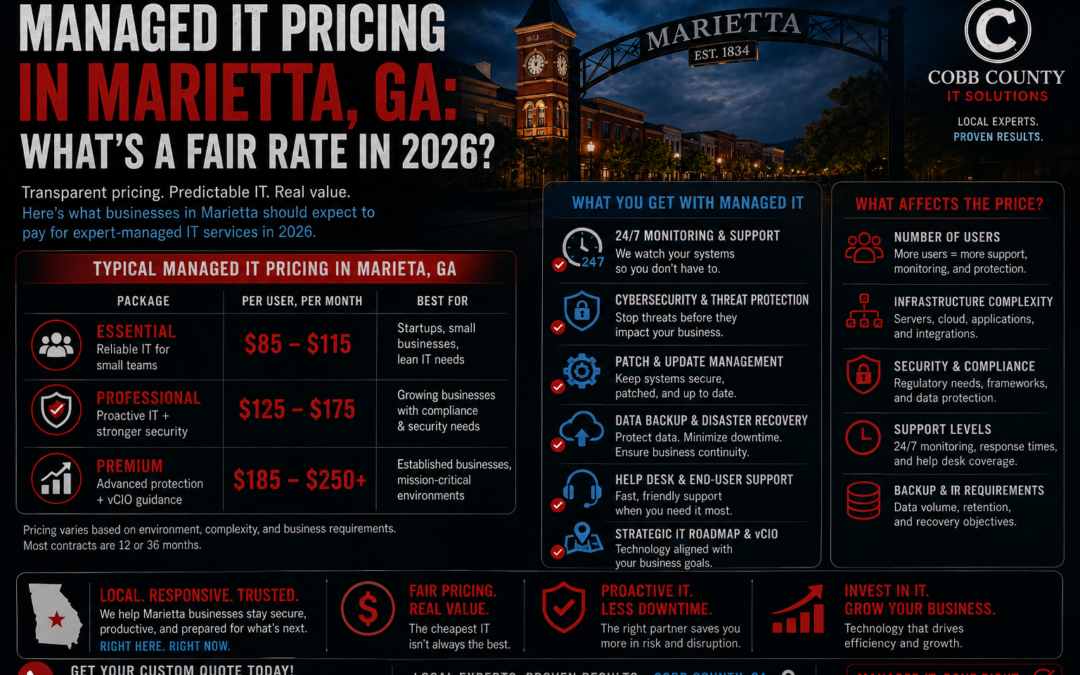
Regional pricing in the metro Atlanta and North Georgia corridor is segmented into four operational tiers. The monthly rate you see on a proposal reflects the coverage scope — and that scope is what determines your financial risk during an actual incident.
| Support Tier | Monthly Cost (Per User) | Core Deliverables | Risk Exposure |
|---|---|---|---|
| Monitoring Only | $35–$75 | RMM software, automated patching, server status alerts | High. No helpdesk, no on-site, no advanced security. |
| Co-Managed IT | $75–$125 | Enterprise security tools, backup management, tier-3 escalation support for existing internal IT | Medium. Duty demarcation gaps must be explicitly documented. |
| True All-Inclusive Managed IT | $150–$250 | Unlimited tier-1–tier-3 remote + on-site, EDR, email security, backup management, vCISO/vCIO advisory | Minimal. Compliance logging, proactive threat hunting, full coverage. |
| Hosted / Premium Cloud | $250–$400 | Private/hybrid cloud, VDI, Zero-Trust remote access, SOC monitoring | Minimal. Designed for regulated legal, financial, and healthcare entities. |
The operative trap: when a contract sits in the $35–$75/user range, every issue outside its narrow automated scope triggers an out-of-scope emergency call. Those calls are billed at $175 to $350 per hour — and a single hardware failure, ransomware triage event, or firewall failure can generate a four-figure or five-figure invoice in a single afternoon. The marginal monthly savings disappear instantly.
Why Does the Cheapest IT Contract End Up Costing the Most?
Low-tier monitoring contracts are written to be cheap on paper and profitable in overage. The mechanism is straightforward: the provider installs a Remote Monitoring and Management (RMM) agent, configures automated patch scheduling, and collects a flat monthly fee. When anything requiring human technical judgment occurs — a ransomware alert, a server RAID failure, a VPN authentication loop — the contract's scope exclusion clause activates and a separate, high-rate emergency ticket is opened.
The practical result for a Marietta business with 20 users on a $50/user/month monitoring contract: the $1,000 monthly baseline evaporates after two emergency calls. At $250/hour, a four-hour firewall remediation event costs $1,000 alone — equaling an entire month of "savings" in a single incident. This is not an edge case. It is the designed revenue model of break-fix and low-tier monitoring providers.
True flat-fee agreements structurally eliminate this exposure. When a provider charges $200/user/month inclusive of all tier-3 on-site labor, their financial incentive is to prevent failures — not bill hours against them.
Is an In-House IT Hire Cheaper Than a Managed IT Contract?
For a 20-user Cobb County firm, the total cost of ownership comparison is unambiguous.
The annualized cost of a single internal IT technician can be expressed as:
$$TCO_{IT} = S + B + T + L + \frac{R}{Y}$$
Where $S$ = base salary | $B$ = benefits and payroll taxes | $T$ = training and certifications | $L$ = software tools and RMM licenses | $R$ = recruiting and onboarding costs | $Y$ = projected employee retention in years
| Cost Element | In-House IT Technician | Managed IT (20-User Firm) |
|---|---|---|
| Base Salary / Monthly Fee | $55,000–$100,000/year | $150–$200/user/month ($36,000–$48,000/year) |
| Benefits & Payroll Taxes | $12,000–$20,000/year | $0 — absorbed by provider |
| Training & Certifications | $2,000–$5,000/year | $0 — provider maintains certified engineering team |
| Software Tools & RMM Licenses | $3,000–$8,000/year | Included in seat cost |
| Recruitment & Sourcing | $5,000–$10,000 upfront | $0 |
| Total Estimated Annual Cost | $77,000–$143,000+ | $36,000–$48,000 |
This model demonstrates a 25% to 45% annual cost reduction for managed IT over a single in-house technician — who also represents a critical single point of failure during PTO, sick leave, or departure. When a solo internal IT hire leaves, the average replacement cycle runs three to six months, during which the organization operates without technical support infrastructure.
Does the Physical Location of Your IT Provider Affect Response Time and Cost?
Yes — and this variable is almost never disclosed in a national aggregator's proposal. Cobb County's mean commute time sits at 31.2 minutes for local workers. That baseline reality shapes everything about emergency on-site response economics.
National IT aggregators price competitively at the base rate by routing all support through centralized remote help desks. When a physical technician is required — a failed network switch, a corrupted RAID array, a server room UPS failure — these providers either:
- Dispatch from a central depot, with travel time ranging from 24 to 72 hours, billed separately as a variable expense.
- Subcontract to loose local networks of unvetted technicians at a third-party markup.
Local footprint providers operating within the North Georgia commercial corridor — servicing the Marietta Square district, East Cobb professional centers, and commercial parks along Dallas Highway and Powder Springs Street — can physically arrive on-site within 2 to 4 hours without travel surcharges. That response differential is the difference between a contained incident and a prolonged outage.
National aggregators also pad apparent savings by excluding onboarding audits, local backup configuration management, and mobile device security patches from the base contract — then billing these as line-item adds. This practice, known in the industry as vendor deflection, allows the remote provider to avoid direct accountability for the physical network layer and local ISP realities.
What Does a Network Outage Actually Cost a Marietta SMB?
The financial consequence of downtime is not abstract. The industry-documented average cost of IT downtime is approximately $5,600 per minute across business categories. For a professional services firm — an East Cobb law practice, a Marietta-based accounting firm, a healthcare group — the loss compounds against billable hour rates, blocked client transactions, and manual administrative recovery.
The outage cost model for any firm can be expressed as:
$$C_{outage} = D \times \left(\frac{E \times H}{60}\right) + R_{loss} + F_{repair}$$
Where $D$ = outage duration in minutes | $E$ = number of impacted employees | $H$ = fully burdened hourly labor rate | $R_{loss}$ = direct per-minute revenue loss from halted billable activity | $F_{repair}$ = flat-fee emergency repair costs
For a 25-employee SMB generating $10 million in annual revenue, a single hour of network downtime can exceed $100,000 when deferred revenue, emergency labor, employee friction, and administrative overtime are fully accounted for.
When a business selects a $50/user/month monitoring contract to avoid a $200/user/month all-inclusive agreement, the monthly savings of $3,000 (on 20 users) are entirely erased by a single afternoon outage. The math is not close.
What Georgia and Federal Laws Apply to Your IT Provider's Compliance Obligations?
Managed IT pricing cannot be evaluated independent of compliance obligations. A provider that saves money by omitting log retention, security risk assessments, and forensic audit readiness is not saving your firm money — it is shifting legal and financial liability onto your leadership team.
Does O.C.G.A. § 10-1-912 Apply to Your Business?
The Georgia Personal Identity Protection Act (GPIPA) applies to any organization operating in Georgia that maintains or handles computerized, unencrypted personal information of Georgia residents — defined as a first name or first initial and last name combined with a Social Security number, driver's license number, or financial account credentials.
Following a security breach, the statute requires notification to affected residents in "the most expedient time possible and without unreasonable delay." Under O.C.G.A. § 10-1-912(b), any third-party vendor maintaining data on behalf of a data collector must notify the data owner within 24 hours of breach discovery.
The practical implication: if your IT provider cannot produce a forensic incident log — because they never deployed proper endpoint monitoring or log retention — your organization cannot determine the scope of the compromise within the legally mandated window. The result is regulatory action and exposure to class-action litigation, not just a technical inconvenience.
Who Does the FTC Safeguards Rule Cover?
The FTC Safeguards Rule applies to non-banking financial institutions: automotive dealerships, tax preparers, consumer finance companies, and mortgage brokers. Covered entities must maintain a formal written information security program, designate a qualified information security officer, conduct vendor risk assessments, and implement technical access controls.
Civil penalties under the FTC Act reach $53,088 per day, per violation. Corporate officers and directors face personal liability for compliance failures. Violators are subject to up to 20 years of continuous FTC monitoring with mandatory biennial third-party security audits at their own expense. Cheap IT agreements omit these controls entirely — the cost reduction is real, and so is the penalty exposure.
What Does HIPAA Require From Your IT Provider in Cobb County?
For healthcare practices and their business associates, HIPAA's Security Rule mandates a documented enterprise-level Security Risk Analysis (SRA) and technical safeguards to record and examine all system activity. The Department of Health and Human Services Office for Civil Rights (OCR) actively enforces these rules in Georgia.
A compliant managed IT provider must:
- Execute a formal, signed Business Associate Agreement (BAA) — a legal prerequisite under HIPAA.
- Maintain certified staff qualified to design and implement HIPAA-compliant security plans.
- Support continuous access logging and audit trail preservation.
Low-cost providers routinely refuse to sign BAAs or lack the certified personnel required to execute mandatory HIPAA policies. Engaging one is not a cost savings — it is a direct HIPAA violation.
What Should a Rigorous Managed IT Contract Include?
Before signing any managed IT agreement in the Cobb County market, verify these four non-negotiable operational standards:
- True Flat-Fee Structure: The contract must explicitly include all tier-1 through tier-3 on-site and remote support with no out-of-scope emergency labor charges. If "on-site visits" or "after-hours escalations" are listed as exclusions or add-ons, the agreement is a monitoring contract, not managed IT.
- Physical Local Dispatch Capability: The provider must maintain a regional technical team capable of arriving on-site in Marietta within 2 to 4 hours for emergencies, without travel multipliers. Require proof of local staffing — not a subcontractor roster.
- Integrated Advanced Security Stack: AI-driven Endpoint Detection and Response (EDR), automated patch management, email security, and encrypted backup management must be included in the baseline seat rate — not sold as optional security add-ons.
- Native Compliance Auditing: The provider must demonstrate documented capability to map their technical controls to Georgia PIPA, HIPAA (where applicable), and FTC Safeguards — and must execute a formal Business Associate Agreement upon request without hesitation.
Isolate Your Infrastructure with IT Emergency Room
Cobb County businesses facing an active network failure, ransomware event, or compliance audit gap do not need a call center queue. They need a Tier-3 on-site escalation team with a physical North Georgia footprint — one that can be at your location within hours, not days.
IT Emergency Room operates as the regional emergency IT response unit for the Marietta Square district, East Cobb professional centers, and the commercial corridors along Dallas Highway. Our all-inclusive managed IT agreements are structured to eliminate the out-of-scope billing traps, provide verified compliance scaffolding under Georgia PIPA, HIPAA, and FTC Safeguards, and maintain the redundant security stack that keeps downtime from becoming a catastrophic financial event.
If your business is experiencing an active IT crisis, or if your current contract cannot answer the four verification questions above, contact the IT Emergency Room emergency response line now.