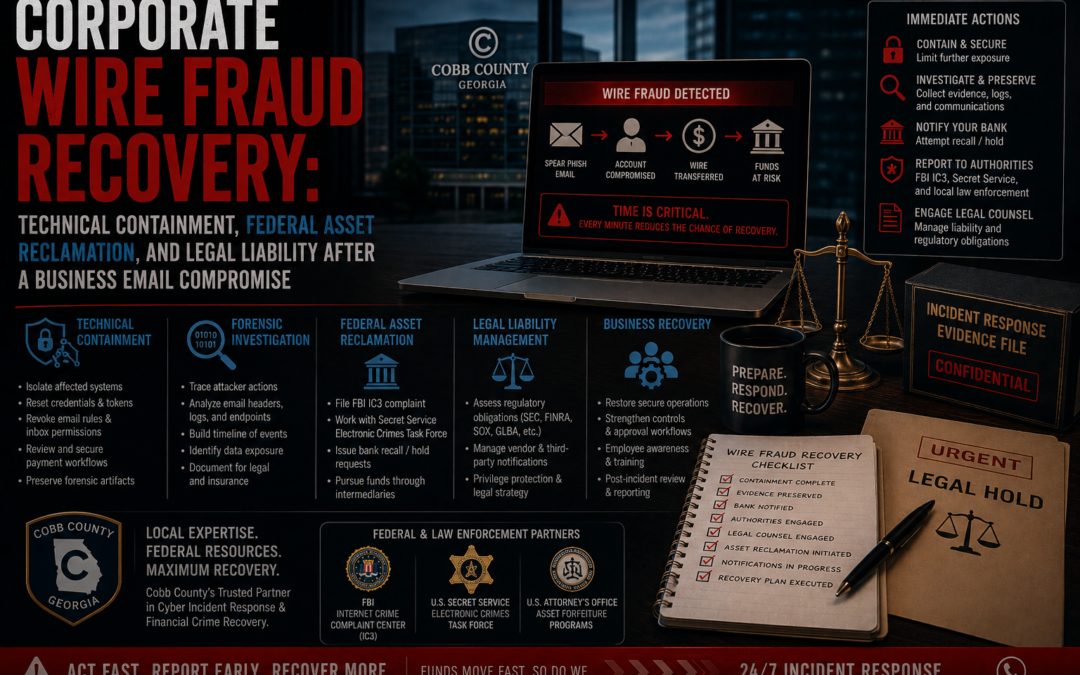
⚡ Executive Triage Summary — Read This First: If a wire transfer was diverted via Business Email Compromise, you have a 72-hour hard window to activate both your bank's Wire Fraud & Risk Operations team and the FBI's IC3 Recovery Asset Team (RAT) — not your local branch manager, not the general 800 number. Under UCC Article 4A, once a wire clears Fedwire with valid credentials, the originating bank bears the loss. Every hour of inaction collapses your legal and federal recovery options. Do not reset passwords and assume the threat is contained; you must programmatically invalidate all active OAuth session tokens or the adversary remains live in your mailbox.
Key Takeaways
- $185,400 total incident cost is the median 24-hour economic impact of a B2B wire diversion — factoring $75K stolen principal, $26.4K idle labor, $60K revenue drain, and $24K SLA penalties.
- 71% (2023) → 58% (2025) recovery rate: the FBI RAT/FFKC program is still highly effective, but its success rate is declining — speed of reporting is the deciding variable.
- UCC Article 4A eliminates bank liability once a wire clears via valid credentials; your recovery path runs through SWIFT/Fedwire recalls and Hold Harmless Agreements, not branch disputes.
- Georgia HB 1034 now mandates state-chartered banks offer a free Account Safety Lock and a 72-hour emergency hold — Cobb County businesses should activate this proactively before an incident occurs.
What Does a BEC Wire Fraud Attack Actually Look Like Inside Your Infrastructure?
Business Email Compromise wire fraud is an invisible operational failure. Unlike ransomware, no system freezes, no ransom screen appears. The theft is discovered only when a real vendor calls to ask why their invoice hasn't been paid. By then, an attacker has already intercepted your email thread and replaced a legitimate payment PDF with an altered version containing fraudulent routing and account numbers.
The interception relies on domain spoofing: the attacker registers a look-alike domain such as vendor-narnme.com (using "r" and "n" to visually simulate "m") or vendor-name-inc.com. These pass casual visual inspection and even some email security filters.
While the visual indicators are subtle, the digital trail across your corporate infrastructure is extensive. The following artifacts are the primary forensic targets for Security Operations Center analysts:
| Log Source / Artifact | Event Identifier / Attribute | Forensic Value & Investigative Target |
|---|---|---|
| Microsoft 365 UAL | New-InboxRule, Set-InboxRule, Add-MailboxPermission |
Identifies unauthorized rule creation and delegate access grants designed to divert incoming mail flow. |
| Windows Security Logs | Event ID 4624 (Logon Type 3 & Type 10) | Identifies malicious interactive or remote desktop access to directory-connected endpoints. |
| Azure AD Sign-In Logs | Client App: IMAP4, POP3, SMTP, Other clients |
Detects legacy protocol authentication attempts that bypass modern security defaults and MFA. |
| Perimeter Firewall Logs | Target IP / Outbound Connection Logs | Tracks persistent connections from internal endpoints to foreign command-and-control servers. |
| M365 Audit Logs | MailboxLogin + riskDetail |
Flags anomalous mailbox access events surfaced by automated identity protection systems. |
⚠ Affected Systems Inventory: The corporate ecosystem under threat spans: Microsoft 365 Exchange Online, Google Workspace, perimeter firewalls, ERP/accounting platforms (QuickBooks Online, Sage), and document repositories (NetDocuments). Each system generates independent forensic artifacts — an investigation that audits only email misses firewall and AD evidence.
Why Resetting Your Password Does Not Stop an Active BEC Compromise
The most dangerous mistake in a live BEC event is the Password Reset Fallacy. A logistics firm near the Barrett Parkway Financial District discovered their corporate controller had been compromised, immediately reset the password through the standard web admin portal — and assumed the threat was contained. It was not.
Because the administrator failed to terminate active sessions, the threat actor's persistent OAuth session tokens and browser cookies remained live. The adversary continued monitoring remediation communications in real-time and sent a second spoofed email impersonating a bank fraud investigator.
This attack model — often delivered via Adversary-in-the-Middle (AiTM) phishing — bypasses both TOTP and push-notification MFA by capturing active session state data, not the credentials themselves.
Programmatic Session Termination: Required Commands
A password reset alone is insufficient. Systems administrators must execute programmatic session invalidation via Microsoft Graph PowerShell:
# Step 1: Connect to Microsoft Graph with appropriate scopes
Connect-MgGraph -Scopes "User.ReadWrite.All", "Directory.ReadWrite.All"

# Step 2: Revoke ALL active sign-in sessions for the compromised user
Revoke-MgUserSignInSession -UserId "compromised.user@yourdomain.com"

# Step 3: Force Azure AD token refresh — invalidates cached OAuth tokens
Update-MgUser -UserId "compromised.user@yourdomain.com" `
  -PasswordProfile @{ ForceChangePasswordNextSignIn = $true }

# Step 4: Audit and remove unauthorized inbox rules
Get-MgUserMailFolderMessageRule -UserId "compromised.user@yourdomain.com" `
  -MailFolderId "Inbox" | Where-Object { $_.IsEnabled -eq $true } | Format-List

# Step 5: Remove any unauthorized delegate access grants
Get-MgUserMailboxSetting -UserId "compromised.user@yourdomain.com"
Remove-MgUserMailFolderMessageRule -UserId "compromised.user@yourdomain.com" `
  -MailFolderId "Inbox" -MessageRuleId "<RULE_ID_FROM_STEP_4>"
🔐 Post-Containment MFA Upgrade: Following programmatic session termination, FBI Cyber guidelines require replacing TOTP and push-notification MFA with phishing-resistant authentication: FIDO2 hardware keys (YubiKey, Titan) or certificate-based authentication (CBA). Standard TOTP is exploitable by AiTM frameworks; hardware keys are not.
What Does a BEC Wire Diversion Actually Cost Your Business in 24 Hours?
The immediate accounting freeze alone — halting all outgoing disbursements, locking normal billable processes, preserving evidence — generates cascading downtime costs before a single hour of recovery work begins. The total incident cost formula:
$$C_{\text{incident}} = L_{\text{theft}} + (W_{\text{idle}} \times T) + (R_{\text{drain}} \times T) + (P_{\text{contractual}} \times T)$$
Where $T$ = downtime duration in hours | $W_{\text{idle}}$ = idle labor cost/hr | $R_{\text{drain}}$ = gross revenue drain/hr | $P_{\text{contractual}}$ = SLA penalty/hr
| Cost Variable | Cost Class | Base Financial Rate | Cumulative Cost (24 Hours) |
|---|---|---|---|
| $L_{\text{theft}}$ — Stolen Principal | Direct Financial Theft | $75,000 (Median B2B BEC Wire) | $75,000 |
| $W_{\text{idle}}$ — Idle Labor Waste | Operational Recovery | $1,100 / Hour | $26,400 |
| $R_{\text{drain}}$ — Gross Revenue Drain | Business Interruption | $2,500 / Hour | $60,000 |
| $P_{\text{contractual}}$ — SLA Fines | Contractual Liabilities | $1,000 / Hour | $24,000 |
| Total Incident Cost — $C_{\text{incident}}$ | Cumulative Synthesis | — | $185,400 |
10-Step Incident Response Framework
When a breach is identified, the following structured protocol — aligned with ALTA guidelines — governs your response sequence:
- Timestamp the Discovery: Record the exact date, time, and responsible party who identified the breach. This timestamp anchors your federal complaint and legal timeline.
- Activate the Incident Response Plan: Notify your legal counsel and IR team immediately. Do not discuss breach details over potentially compromised channels.
- Secure Physical and Digital Premises: Lock down access to affected endpoints and server rooms. Preserve the physical chain of custody for forensic evidence.
- Isolate — Do Not Power Down: Take affected machines offline immediately. Do not power them down or run antivirus scans — volatile memory data (active sessions, encryption keys) will be destroyed.
- Document Everything: Record which systems are affected, what assets were targeted, who had access, and every action taken since discovery.
- Interview Key Personnel: Establish a timeline: who sent or received what, when, and through which channels. Identify the initial point of compromise.
- Lock Internal Communications: Review and restrict communication protocols to prevent accidental broadcast of breach details — especially to the adversary if mailbox access persists.
- Triage Immediate Risks: Prioritize: is the mailbox still compromised? Have client databases been accessed? Are additional wire transfers pending?
- Engage a Digital Forensics Firm: Bring in a qualified DFIR team before touching compromised systems. Premature remediation destroys evidence and undermines insurance and legal claims.
- Formally Notify Law Enforcement — After Consulting Counsel: File with FBI IC3 and local law enforcement. The sequence of notifications matters for statute of limitations and federal recovery eligibility.
Why Your Bank Is Not Legally Required to Refund a Commercial Wire Transfer
Commercial bank accounts are not protected under the Electronic Fund Transfer Act (EFTA) Regulation E. Commercial business accounts are not. Commercial wire transfers are governed exclusively by Uniform Commercial Code Article 4A — and this distinction eliminates most bank liability.
Under UCC 4A: if a financial institution executes a wire using valid security credentials and authenticated MFA tokens, the bank bears no obligation to reverse the transaction once it has cleared the Fedwire network. The originating commercial institution absorbs the loss.
❌ The Local Branch Manager Myth: Calling your local branch manager is the slowest possible escalation path. Branch staff typically lack direct access to federal asset recovery portals or Fedwire clearing systems. You must bypass standard support entirely and contact the bank's Wire Fraud & Risk Operations Department directly — immediately.
The Recovery Instrument Stack: What to File and When
| Timeframe | Recovery Instrument / Action | Functional Requirements & Scope |
|---|---|---|
| Hour 0–4 | SWIFT Recall Request (International) or Fedwire Recall Request (Domestic) | Issued by the originating bank. Must be accompanied by a Hold Harmless Agreement or Letter of Indemnity. |
| Hour 0–24 | Hold Harmless Agreement — UCC 4A Return Window | UCC provisions provide a 24-hour return timeframe for executing a recall under Hold Harmless. Missing this window forecloses the fastest recovery path. |
| Hour 0–72 | FBI IC3 Complaint + RAT Activation | File a detailed complaint at IC3.gov. The RAT reviews and contacts the receiving bank's fraud team to request an administrative account freeze. |
| Post-72 Hours | Breach of Warranty Action | If the 24-hour UCC window is missed, recovery proceeds via Breach of Warranty litigation. Statutory timeframe: 1–3 years. Legal costs significantly higher. |
| Ongoing | Fraud Affidavit | Required by the bank: a formal legal attestation that the organization did not benefit from the transaction and will cooperate as a witness in any resulting criminal proceedings. |
⚠ OFAC Compliance Layer: Domestic wires clear via Fedwire (real-time gross settlement) or CHIPS (private-sector interbank). All transactions must pass Office of Foreign Assets Control (OFAC) screening before any recall or freeze can be executed — a compliance step that introduces procedural delay even in straightforward domestic cases.
How the FBI's RAT and FFKC Programs Actually Work — and When You Qualify
The FBI's IC3 Recovery Asset Team (RAT), established February 2018, is the primary federal mechanism for coordinating real-time fund freezes between law enforcement and financial institutions. Two distinct recovery pathways exist, with different eligibility thresholds:
International Financial Fraud Kill Chain (FFKC)
The FFKC triggers an automated international administrative freeze. To qualify, a transaction must simultaneously meet all four criteria:
- Transaction value ≥ $50,000
- Transfer is international in destination
- Formal SWIFT Recall Request initiated by the sending bank
- Incident reported to FBI within 72 hours of transmission
Wires outside these criteria can still be reported to IC3 but do not trigger FFKC's automated international freezing protocols.
Domestic Recovery Asset Team (RAT) Process
For domestic-to-domestic transfers, the RAT operates without a minimum dollar floor. File a detailed IC3.gov complaint; the RAT contacts the receiving bank's designated fraud team to request an administrative account freeze, then alerts the appropriate local FBI field office.
| Performance Metric | 2023 | 2024 | 2025 (Preliminary) |
|---|---|---|---|
| Total Incidents Managed | 3,008 managed | 3,020 complaints | Data not fully released |
| Attempted Theft Value | $758,052,433 attempted | $848.4 million attempted | Data not fully released |
| Freezing Success Rate | 71% success rate | 66% success rate | 58% success rate (~$680M frozen) |
📊 Analyst Note — Declining Recovery Rate: The FFKC/RAT success rate has declined from 71% (2023) to 58% (2025). This degradation tracks directly with increasing adversary speed in moving funds through layered crypto-exchange pipelines. Speed of IC3 reporting is now the primary variable separating recoverable from unrecoverable losses.
Georgia HB 1034, O.C.G.A. § 10-1-912, and Cobb County Coordination: What Local Businesses Must Know
Georgia House Bill 1034, signed by Governor Brian Kemp, establishes state-level statutory recovery mechanisms that supplement — and in some cases exceed — federal FFKC/RAT protections for businesses banking with state-chartered institutions.
HB 1034: Mandatory Bank Requirements
Free Account Safety Lock: State-chartered financial institutions must offer a free Account Safety Lock accessible online and by phone. Activation immediately blocks new payee creation, sets outbound transfer limits to zero, and terminates all active online sessions. The lock remains until the customer completes high-assurance re-authentication (in-person, notarized instructions, or verified callback).
Remote Access Detection Mandate: If a financial institution detects an active remote access session or remote administration software during a transaction, it must pause the transfer and require high-assurance re-authentication or in-person verification before proceeding.
72-Hour Emergency Hold: Upon a customer reporting suspected fraud, the institution must impose a temporary emergency hold on any covered transfer prior to final settlement. The hold may be maintained for 72 hours during internal risk review, with a single 72-hour extension granted upon written law enforcement request or formal police report submission.
Mandatory Notification Timeline: Banks must notify the customer of the hold within 1 business day, and share the final outcome within 3 business days after the hold is released. All records must be retained for 5 years.
🏙 Insider Nuance — Cobb County Operational Risk: Financial personnel operating in the Barrett Parkway Financial District, Town Center Kennesaw business parks, and Marietta Square routinely access mobile accounting applications over unencrypted public Wi-Fi along regional transit corridors. This exposes live session data to localized interception by AiTM-capable threat actors — making the in-transit accounting workflow one of the highest-risk surfaces for Cobb County organizations.
For state-level recovery coordination, Cobb County businesses should engage both the Cobb County Police Department's Financial Crimes Unit and the Georgia Bureau of Investigation's Cyber Crimes Unit in parallel with FBI IC3 filings. State-level coordination is not an alternative to federal reporting — it is additive and required for HB 1034 emergency hold activation at the institutional level.
What Operational Controls Actually Stop Wire Fraud Before It Happens?
Control 1: Dual-Channel Vendor Routing Validation
Any request to alter vendor routing numbers, bank account details, or payment schedules must be verified over a separate, trusted voice channel — using a phone number sourced from the partner's official website or physical contract, never from within the email request. Do not call general "800 numbers" when contacting your own banking partners during an incident; these public support lines introduce administrative delays that collapse your recovery window.
Control 2: Two-Stage Transaction Validation (Penny Test Protocol)
For high-value transactions: first transfer a small, random test amount to the recipient account. The sender must receive verbal confirmation over a trusted voice channel that the exact amount was received before releasing the remaining balance. This protocol catches account substitution before the principal is lost.
Control 3: Multi-Signatory Wire Authorization
Implement a mandatory segregation of duties policy for all wire transfers. No single individual may both initiate and approve a transaction. Payment initiators enter requests; two independent, authorized signatories must verify and approve before clearance. This eliminates single-point-of-failure authorization vulnerabilities.
Control 4: Identity Directory Hardening
Strengthen the underlying identity infrastructure with the following baseline controls:
# Enforce Conditional Access: Block legacy authentication protocols
# (IMAP4, POP3, SMTP auth) — primary AiTM bypass vectors

Set-TransportConfig -SmtpClientAuthenticationDisabled $true

# Enable Microsoft Defender for Identity — monitors AD for
# lateral movement, pass-the-hash, and Kerberoasting indicators

# Enforce FIDO2 hardware key requirement for all financial roles
# in Azure AD via Conditional Access Authentication Strength policy

# Quarterly: Review M365 UAL for New-InboxRule anomalies
Search-UnifiedAuditLog -StartDate (Get-Date).AddDays(-90) `
  -EndDate (Get-Date) -Operations "New-InboxRule","Set-InboxRule" `
  -ResultSize 5000 | Export-Csv -Path "InboxRuleAudit.csv"
Additionally, maintain a rolling 12-month End-of-Life system forecast to retire vulnerable technologies, and operate risk-based vulnerability management where critical system remediations are measured in days — not months.
Isolate Your Infrastructure with IT Emergency Room — Cobb County's Tier-3 On-Site Crisis Unit
If your organization is in an active BEC incident right now — or if you've discovered a suspicious wire transfer within the past 72 hours — you are inside the federal recovery window. Every hour of internal deliberation is an hour of frozen-fund eligibility you cannot recover.
IT Emergency Room is the Cobb County area's designated Tier-3 on-site escalation unit for infrastructure crisis response. We deploy directly to your facility, execute programmatic session invalidation, conduct live Microsoft 365 UAL forensic triage, and coordinate your parallel bank recall and FBI IC3 filing within a single mobilization window.
We serve the Barrett Parkway Financial District, Town Center Kennesaw business parks, Marietta Square, and surrounding Cobb County business corridors — on-site within hours, not days.
🚨 Call the Emergency Response Line Now
Or submit a priority intake at itemergencyroom.com — monitored 24/7/365