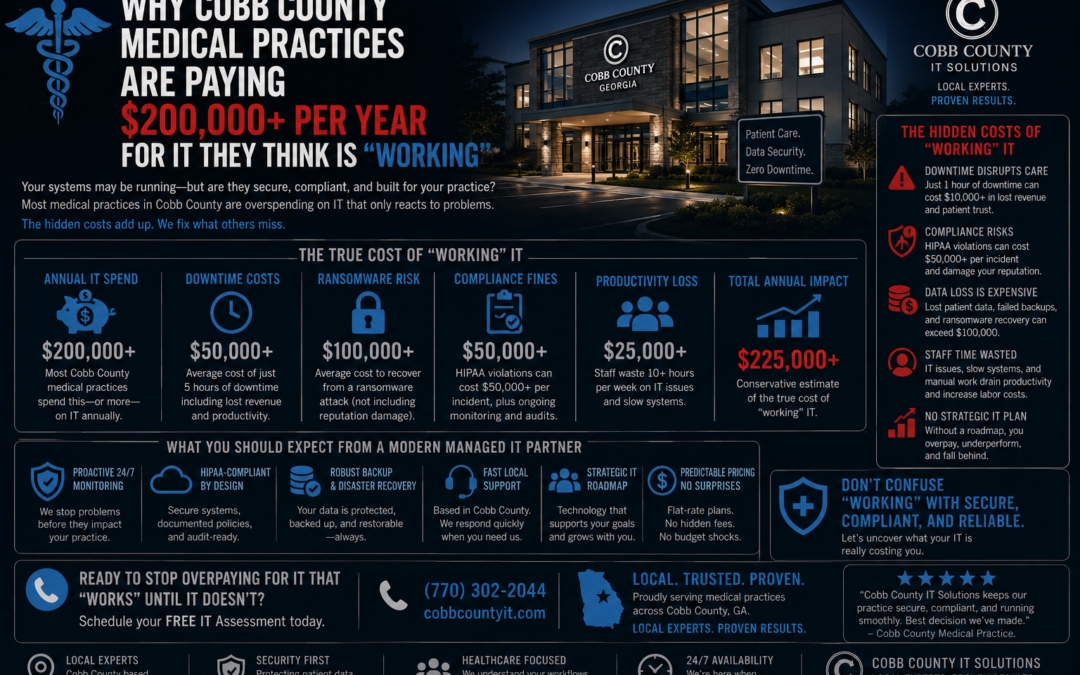
Why Cobb County Medical Practices Are Paying $200,000+ Per Year for IT They Think Is "Working"
Executive Triage Summary: A standard 99% uptime server contract costs a 20-provider Cobb County practice over $202,000 annually in hidden downtime losses alone—before any breach occurs. The ApolloMD ransomware gang needed 22 seconds to hand off initial access to a full deployment crew. Alpha Medical Centre in Alpharetta closed permanently after a February 2025 RansomHub attack exposed 1,714 unencrypted patient records. Transitioning to an advanced, protective managed IT services framework eliminates the cost gaps of the reactive break-fix model, which remains financially incompatible with clinical operations at any scale.
Key Takeaways:
- 22 seconds is the current window between an attacker gaining initial access and deploying ransomware—human helpdesk intervention is categorically too slow to interrupt this chain.
- $488/hour per physician is the median quantified downtime cost for ambulatory practices when EHR and scheduling systems go offline.
- O.C.G.A. § 10-1-912 requires breach notification to all affected Georgia residents and, for incidents exceeding 10,000 records, mandatory notice to the state Attorney General's office—within the tightest defensible window available.
- 6-year immutable log retention is a hard federal mandate under 45 CFR § 164.316(b)(2); low-cost IT providers routinely overwrite logs every 30–90 days, creating a compliance vacuum that OCR investigators treat as evidence of willful neglect.
What Does a Real Healthcare Ransomware Attack Look Like in Georgia?
Two documented Georgia incidents from 2025 define the current risk floor for independent and multi-physician practices.
The ApolloMD breach compromised 626,540 patients across 125+ affiliated practices. The Qilin ransomware group's full operational presence lasted between May 22 and May 23—a 24-hour window in which threat actors exfiltrated complete datasets: names, dates of birth, addresses, diagnostic codes, treatment records, insurance IDs, and Social Security numbers. The attack vector was a credential-based intrusion that standard perimeter defenses never flagged.
Alpha Medical Centre in Alpharetta—a practice operating for over twelve years—permanently closed on April 18, 2025. The RansomHub intrusion was first detected on February 3, 2025. By the time forensic teams confirmed the scope, the unencrypted PHI of 1,714 patients had been exfiltrated, including names, addresses, emails, phone numbers, insurance details, and appointment logs. The practice could not absorb the combined weight of system remediation costs, reputational damage, and looming regulatory liability. It dissolved.
These are not anomalies. They are the actuarial baseline.
How Fast Do Modern Ransomware Operators Actually Move?
The forensic answer eliminates any argument for reactive IT support.
Initial access to ransomware deployment now takes 22 seconds. In 2022, the handoff window between an access broker and a ransomware execution crew averaged over eight hours—long enough for a competent helpdesk to detect and respond. That window has collapsed by more than 99%. A Cobb County practice that calls an external technician after a server alert fires has already lost.
The mean time to detection (MTTD) across all breach investigations is 181 days. Containment adds another 60. That is a 241-day operational lifecycle during which threat actors harvest credentials, stage data, map backup infrastructure, and position for maximum extortion leverage—all while routine clinical operations continue.
| Threat Vector / Breach Metric | Modern Enterprise Healthcare Benchmark | Forensic and Compliance Reality |
|---|---|---|
| Initial Access Hand-off Window | 22 Seconds | Lateral network compromise is complete before helpdesk triage begins |
| Mean Time to Detection (MTTD) | 241-Day Lifecycle | Silent credential harvesting and data staging occur over months |
| Average U.S. Breach Mitigation Cost | $10.22 Million | Forensic audits, class-action litigation, permanent patient loss |
| Healthcare Sector Breach Average | $11M–$12.6M | Highest of any regulated industry globally |
| Ransomware + Exfiltration Rate | 44% of incidents | Backup-only recovery strategy is forensically void; stolen data posts on dark web leak sites |
| Compromised Credential Entry Rate | 22% of all breaches | OAuth token harvesting bypasses MFA entirely |
What Does IT Downtime Actually Cost a Medical Practice in Cobb County?
The math is quantifiable, not theoretical.
When an EHR or clinical scheduling system goes offline, clinical labor does not stop—it converts to manual documentation workflows. Financial modeling of ambulatory practice operations shows that for every one minute a clinical application is unavailable, staff require 2.15 minutes of subsequent administrative labor to perform the task manually and then re-enter the data post-recovery. This administrative multiplier compounds the loss.
The result: $488 per hour for every active physician on staff.
| Annual System Availability SLA | Total Unplanned Downtime/Year | 5-Provider Practice | 20-Provider Practice | 50-Provider Practice |
|---|---|---|---|---|
| 96.0% (Low-Tier Server) | 104 Hours | $253,760 | $1,015,040 | $2,537,600 |
| 98.0% (Standard Workstation) | 52 Hours | $126,880 | $507,520 | $1,268,800 |
| 99.0% (Commodity Server) | 26 Hours | $63,440 | $202,365 (SLA Loss Baseline) | $634,400 |
| 99.5% (Redundant Server) | 13 Hours | $31,720 | $126,880 | $317,200 |
| 99.9% (Data Replication) | 156 Minutes | $6,344 | $25,376 | $63,440 |
| 99.99% (High-Availability Software) | 15.6 Minutes | $634.40 | $2,537.60 | $6,344 |
| 99.999% (Fault-Tolerant Infrastructure) | 1.56 Minutes | $63.44 | $253.76 | $634.40 |
A 20-provider practice on a commodity 99.0% SLA—the default configuration sold by most regional low-cost IT shops—loses over $202,000 annually before a single breach, ransomware event, or regulatory action occurs. Moving to a high-availability 99.99% architecture reduces that exposure significantly. The cost delta between a mediocre and a properly engineered environment is smaller than the loss it prevents.
What Does Georgia Law Actually Require After a Healthcare Data Breach?
O.C.G.A. § 10-1-912 governs breach response for any commercial entity that collects, transmits, or maintains unencrypted computerized data containing Georgia residents' personal information—which includes every healthcare practice in Cobb County operating an EHR.
The 24-Hour Custodian Rule: Any entity maintaining data on behalf of a primary data collector must notify that collector of any system breach within 24 hours of discovery. This creates a direct, enforceable liability chain between your IT vendor and your practice.
Bulk Notification Threshold: If a breach requires notifying more than 10,000 Georgia residents simultaneously, the data collector must notify the state Attorney General's office and all national consumer reporting agencies—not just the patients themselves.
Mandatory Notification Content: Consumer notifications must contain a specific general description of the incident, the types of personal information compromised, the technical remediation steps taken, direct contact information, and explicit consumer self-protection guidance. Generic "we take your security seriously" language does not meet the statutory standard.
Substitute Notice Rules: Direct written notice is required unless the cost exceeds $50,000, the affected population exceeds 100,000, or sufficient contact information is unavailable. Substitute notice requires simultaneous email outreach, a conspicuous website post, and notification to major statewide media outlets.
At the federal layer, HIPAA Security Rule 45 CFR § 164.312(b) requires continuous hardware, software, and procedural mechanisms to record and examine all system activity touching ePHI. 45 CFR § 164.316(b)(2) mandates that all policies, procedures, assessments, and audit logs be retained for a minimum of six years from creation or last effective date.
What Have OCR Enforcement Actions Looked Like for Georgia Healthcare Entities?
Five documented regional enforcement actions establish the enforcement pattern across North Georgia.
| Regulated Georgia Entity | Primary Cause of Enforcement | Financial Settlement | Corrective Action Term |
|---|---|---|---|
| Athens Orthopedic Clinic | Vendor credential compromise; no enterprise risk analysis; missing BAAs; no written policies | $1,500,000 | 2 years active monitoring |
| Peachstate Health Management (AEON Labs) | No security risk assessment; no system audit logging | $25,000 | 3 years under independent HIPAA monitor |
| Great Expressions Dental Center of Georgia | Failure to provide timely patient record access under Right of Access Initiative | $80,000 | Multi-year corrective plan |
| West Georgia Ambulance | No risk analysis; no security training; no written Security Rule policies | $65,000 | Multi-year workforce training audits |
| MMG Fusion, LLC (Business Associate) | Impermissible disclosure of 15 million patients' PHI; failure to notify covered entities | $10,000 | 3 years, mandatory risk analysis audits |
The Athens Orthopedic settlement is operationally instructive. The $1.5 million penalty did not arise from the breach itself—it arose from what OCR found in the aftermath: no risk analysis had ever been conducted, no Business Associate Agreements existed with key vendors, and no written HIPAA policies were in place. These are the exact gaps that low-cost IT providers leave unaddressed because the SRA, BAA, and policy architecture are treated as billable add-ons rather than contract inclusions.
The Peachstate enforcement reinforces a second point: the indirect costs of a corrective action plan often exceed the monetary penalty. A three-year independent monitor with HIPAA expertise embedded in operations is an ongoing operational overhead that compounds across the full supervision period.
How Do Managed IT Pricing Models Actually Compare?
The standard mistake in IT procurement is treating a monthly per-seat figure as a complete price. It is not. It is the floor below which the real costs begin.
A documented onboarding assessment of a multi-partner firm near Marietta Square illustrates the gap. The practice paid a low-cost provider $900/month flat. When their primary firewall failed on a Friday afternoon, the contract explicitly excluded after-hours infrastructure emergencies. The emergency dispatch rate ran at $250/hour, and the total unexpected labor cost ran to thousands of dollars before the network was restored—on top of clinical revenue lost during the extended outage window.
National IT aggregators compound this with geographic surcharges. Practices in Marietta or East Cobb frequently discover that the flat monthly rate quoted by a national MSP includes travel dispatch multipliers for any technician crossing the I-285 perimeter. These clauses turn a standard on-site call into an invoice line item that was never in the budget.
| Cost Parameter | Low-Tier "Monitoring Only" | True All-Inclusive Managed IT | Co-Managed IT |
|---|---|---|---|
| Typical Monthly Pricing | $35–$75 per user/month | $150–$250 per user/month | $75–$125 per user/month |
| Core Inclusions | Basic device health alerts; passive remote monitoring | Unlimited Tier-3 helpdesk; advanced EDR; email security overlays | Advanced security tools; backup monitoring; Tier 2/3 escalation |
| What's Excluded | Active helpdesk; patching; incident response | Custom dev; raw hardware; out-of-scope projects | Tier-1 resets; onboarding; direct user support |
| Emergency Surcharges | $175–$350/hr; weekend dispatch fees | Fully included 24/7 | Dependent on SLA tier |
| Log Retention | Overwritten every 30–90 days; no WORM archival | 6-year encrypted immutable WORM vault | Shared responsibility; MSP provides tooling |
| Compliance Scaffold | Excluded; HIPAA consulting billed separately | Built-in annual SRA; verified BAAs; security plan creation | NIST CSF aligned; compliance reporting support |
The 30–90 day log rotation window on low-tier contracts is not merely an inconvenience—it is a direct HIPAA violation waiting to materialize. When OCR issues a data request following an incident, and a practice cannot produce 6-year audit logs because its $50/seat vendor was overwriting them quarterly, the investigation shifts from a breach inquiry to a willful neglect determination.
What Logging Architecture Does Federal Law Actually Require?
45 CFR § 164.312(b) requires continuous hardware, software, and procedural mechanisms to record and examine activity in all systems containing ePHI. When a breach occurs, investigators must reconstruct the full access path to determine which accounts were compromised and which patient records were exposed. That reconstruction is only possible if the logs exist, are complete, and have not been altered.
Four non-negotiable technical safeguards define a compliant architecture:
- Separated Log and Database Credentials: Application logs must never write to the same database environment hosting the clinical application. If an attacker compromises the primary database, they can overwrite or delete logs to eliminate their forensic trail. Logs must write to a completely isolated, append-only destination.
- PHI Exclusion from General Telemetry: Standard application debug logs frequently capture plain-text patient names, emails, and medical record numbers embedded in request bodies or database query errors. Sending these to third-party log services without a verified BAA constitutes a direct HIPAA violation.
- Immutable WORM Archiving: Audit trails must use Write Once, Read Many (WORM) technology or tamper-proof cryptographic hashing. AWS S3 object versioning with strict lifecycle policies prevents any user—including system administrators—from altering or deleting logs for the federally mandated six-year retention window.
- AI/LLM Telemetry Controls: If a clinic deploys AI or large language models to process patient data, the infrastructure must capture every prompt sent, every response received, standardized UTC timestamps, user IDs, the specific model version, and all token usage metadata.
Every ePHI access event log must contain structured metadata in this format:
{
  "timestamp": "2026-06-26T12:19:00Z",
  "user_id": "usr_cobb_physician_809",
  "action": "READ",
  "resource_type": "patient_chart",
  "resource_id": "pat_marietta_99012",
  "contains_phi": true,
  "client_ip_address": "172.56.21.104"
}| Technical System Event | Required Metadata | Forensic Purpose | Compliance Mapping |
|---|---|---|---|
| Authentication & Access | Timestamp; user ID; IP; success/fail; MFA token status | Identifies credential stuffing and unauthorized session hijacking | 45 CFR § 164.312(b) unique user access auditing |
| ePHI Database Queries | User ID; database operation; resource ID; patient identifier | Proves whether an attacker read, modified, or deleted patient charts | Minimizes reporting scope under Georgia access statutes |
| Privileged Actions | Target user ID; permission changes; role creation/deletion; admin ID | Tracks unauthorized privilege escalation | Fulfills RBAC and workforce authorization audits |
| Infrastructure Changes | Firewall rule changes; API key lifecycle; encryption key rotations | Detects attempts to weaken defenses or expose local databases | Meets transmission security technical safeguard standards |
| AI / LLM Inferences | Prompt text; model output; model ID; token usage; user ID | Detects accidental data leakage in AI workflows | Aligns with administrative risk management and BAA vendor controls |
| Data Export & Backup | Target destination; transfer protocol; file size; compression parameters | Identifies data staging and exfiltration before ransomware encryption | Satisfies 24-hour custodian notice trigger under O.C.G.A. § 10-1-912 |
What One-Department Incident Response Requirements Should Cobb County Practices Demand?
Before signing any managed IT agreement, clinical leadership must validate four non-negotiable provisions:
- Local Dispatch SLA of Two Hours or Less: The master service agreement must explicitly guarantee on-site emergency dispatch within two hours for critical infrastructure failures—server crashes, firewall failures, and network outages. Any contract referencing travel multipliers to cross I-285, or lacking a dedicated engineering hub within Cobb County, is structurally incompatible with clinical uptime requirements.
- Annual Security Risk Assessment as a Core Inclusion: The SRA must be built into the base contract—not sold as an out-of-scope add-on. It must produce a documented risk mitigation roadmap covering workstation security, mobile device encryption, and network segmentation. OCR investigators use the absence of an SRA as the opening evidence in every enforcement action reviewed above.
- Contract-Enforced Business Associate Agreements: BAAs must be pre-signed with all technical partners before any systems go live. The agreement must specify the vendor's liability limits, require proof of cybersecurity insurance, and explicitly require immutable log retention for the full six-year federal mandate. A vendor that cannot produce a signed BAA before onboarding is a vendor that has already created a HIPAA exposure for your practice.
- Annual Multi-Department Incident Response Tabletop Exercises: Clinical, legal, and IT teams must rehearse emergency workflows together at least annually—including manual paper charting protocols, backup restoration speed testing, and breach notification decision trees under O.C.G.A. § 10-1-912. Practices that have never rehearsed these workflows make critical, defensible decisions under maximum operational stress during an actual event.
Stabilize Your Clinical Infrastructure
Practices in Marietta Square, East Cobb professional centers, and the commercial corridors along Dallas Highway and Powder Springs Street are facing the same adversary landscape that permanently closed Alpha Medical Centre in Alpharetta and generated $1.5 million in OCR penalties for Athens Orthopedic. The threat actors are local in their targeting and global in their capability.
IT Emergency Room operates as Cobb County's dedicated Tier-3 on-site escalation unit for healthcare practices. On-site dispatch, verified BAA execution, WORM-compliant log infrastructure, and annual SRA delivery are core contract inclusions—not billable line items discovered during a crisis.
If your current IT contract does not include a two-hour local dispatch SLA, an annual SRA, pre-signed BAAs, and immutable six-year log retention, your clinical risk exposure is active.
Request a Secure HIPAA Compliance & Cyber Risk Audit
Do not wait for a ransomware deployment script to test your network's response window. Secure an elite physical and forensic appraisal of your current infrastructure, logging configuration, and BAA liabilities.
Access the Private B2B Clinical Risk Appraisal Portal or initiate immediate emergency escalation via our direct medical defense routing lines:
Emergency Escalation Line: (678) 439-9501 | Digital Registry Secure Desk: itemergencyroom.com